

The house on Highway 54 sat quiet that June morning, surrounded by tall grass that had long outgrown the fence line. Neighbors passed by without looking twice; it was the sort of home people learned not to ask about. A place where the curtains never moved, where the lights flickered at odd hours, where silence was rarely peaceful — only heavy.
Inside that house, in a room where the wallpaper peeled from the corners and the air was thick with the stale scent of neglect, an eight-month-old baby girl was buried in silence long before the world even knew she was gone.
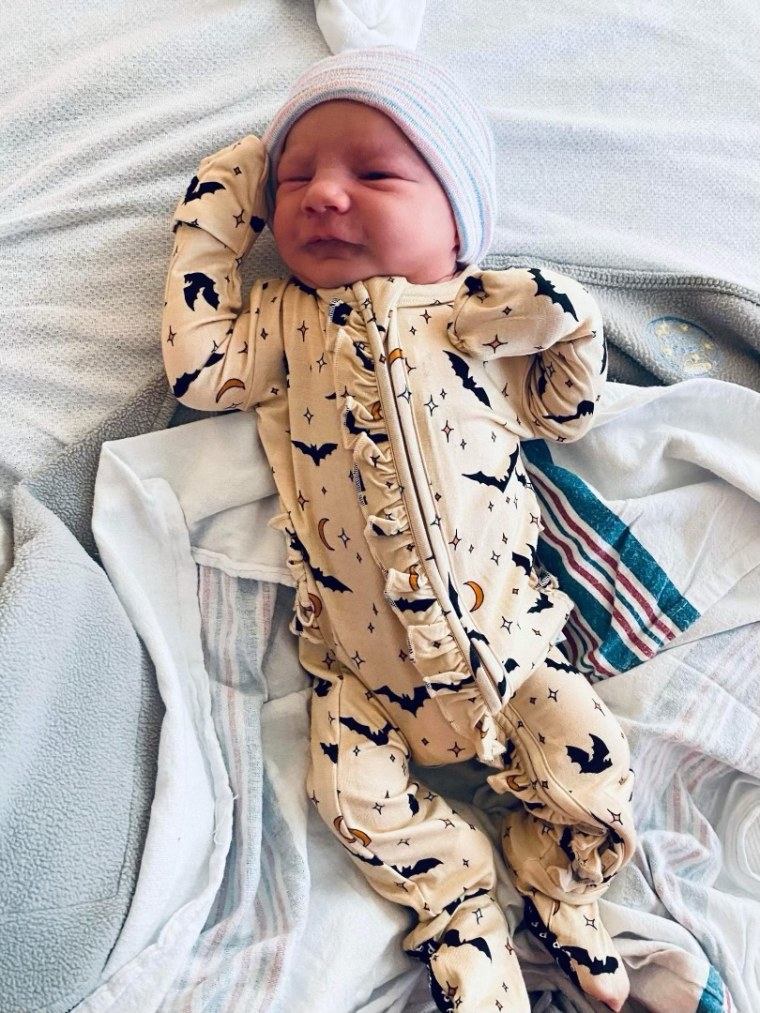
Her name was Miya.
She had soft cheeks, dark eyes, and a cry so faint that even her closest family barely remembered it. Some might say she never had a chance. Others would say she was failed — first by addiction, then by apathy, and finally by the people who should have loved her most.
But Miya was not just a victim.
She was a child who deserved to be seen, to be held, to be protected.
And this is her story — the story the duffel bag could not bury.
I. THE DAY SHE DISAPPEARED
It began with a missing child alert.
June 6, 2024 — Kentucky State Police held a press conference. Their tone was urgent, their faces drawn tight with dread.
“Eight-month-old Miya Rudd has been reported missing. Any information is needed immediately.”
To the public, it sounded like a disappearance.
Inside the walls of the Rudd home, it had already been something far worse.
When officers arrived days earlier, they hadn’t just found a messy home. They found a collapsed world — piles of debris, rotting food, bottles coated in residue, the unmistakable stench of chemical smoke.
The sort of environment where innocence cannot survive for long.
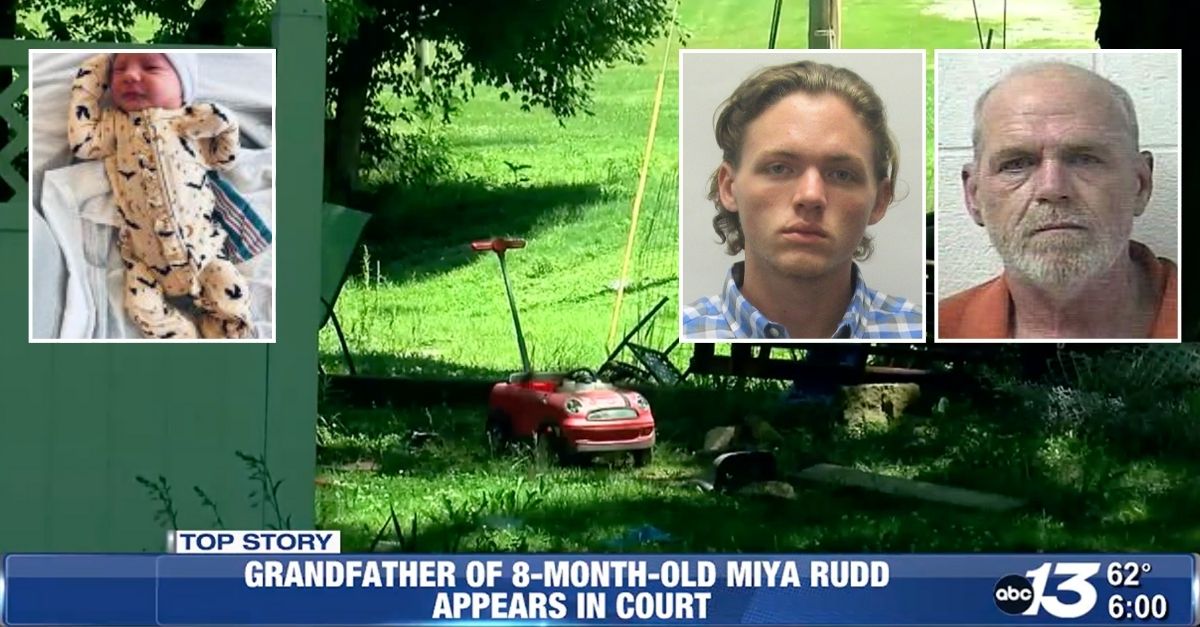
Her mother, Tesla Tucker, and her father, Cage Rudd, were arrested on drug-trafficking charges. Their eyes were hollow, their speech erratic. Miya was not with them.
Her grandparents, Ricky Smith and Taletha Tucker, were questioned. A stranger named Brodie Payne, who had been living there for six months, was taken into custody too.
Everyone had an answer — but none of them added up.
An infant cannot simply vanish.
Something darker had happened.
Something that would haunt the investigators for the rest of their careers.
II. THE DISCOVERY
It was one week later when the truth finally emerged.
Officers returned to the property — not because they expected to find Miya alive, but because they were running out of places to look. A K-9 unit circled the house, pausing near a bedroom closet.
Inside, beneath piles of discarded clothing and debris, they found a duffel bag.
Zipped shut.
Heavy.
Too heavy for something that was supposed to be empty.
When the officer opened it, the smell hit first — the unmistakable, devastating scent of decomposition.
Inside the duffel bag was the body of baby Miya.
Eight months old.
Alone.
Hidden.
Left in the dark as the life she had barely begun faded away.
Investigators would later describe the scene as something they would never forget — not in all their years, not in all their cases. Some walked outside and cried. Others went quiet and remained that way for days.
Miya had been gone long before anyone bothered to say her name out loud.
III. A HOUSE OF SECRETS
The Rudd home was more than a crime scene — it was the physical manifestation of addiction’s cruelty. Meth residue coated the surfaces. Trash lined the floors. Rooms were so cluttered that officers could barely step inside.
Neighbors said they rarely saw the baby. Sometimes they didn’t even know she had been born.
A few heard crying once or twice, but it never lasted long.
Addiction has a way of drowning out everything — responsibility, love, even the sound of a child’s plea for help.
Inside that house lived:
• Her father, Cage — 30
Battling addiction, spiraling into the depths of meth dependence, losing grip on reality.
• Her mother, Tesla — 29
Struggling with her own demons, numbing herself until even motherhood slipped away.
• Her grandparents, Ricky and Taletha
Caught in the same cycle, offering no anchoring force, no refuge.
• And Brodie, a stranger to the family tree but not to addiction, living among them in chaos.
Drugs were not a factor in this case — they were the foundation.
The silent puppeteer pulling every string.
IV. FIVE PEOPLE, ONE CONSPIRACY
Police collected evidence, piecing together the days before Miya’s death like fragments of a broken mirror.
Someone knew she was dead.
Someone hid the body.
Someone zipped the duffel bag.
Someone stacked debris on top of it to conceal it.
And someone decided that her disappearance should be a secret kept at any cost.
The indictment listed the charges plainly:
Murder.
Abuse of a corpse.
Conspiracy.
Criminal neglect.
Trafficking methamphetamine.
Five names.
One house.
One infant who never had a voice.
V. THE FATE OF THE ACCUSED
In the months that followed, two men — Smith and Payne — faced sentencing for their roles in the conspiracy.
More trials await.
Miya’s mother, father, and grandmother remain at the center of the homicide investigation.
The question still haunts the courtrooms:
Who killed baby Miya?
And why?
Police believe the truth lies somewhere in the tangled, toxic web of addiction, guilt, and denial.
VI. WHO MIYA COULD HAVE BEEN
Stories like this often end with the crime — but Miya’s story began long before the duffel bag.
She had a name.
She had a laugh.
She had tiny fingers that clenched when someone touched her palm.
She had eyes that searched for light, even in a dark house that offered her so little.
She could have walked one day.
She could have said her first word.
She could have been someone’s sister, someone’s best friend, someone’s joy.
But instead, her life was spent in a house that had no space for hope.
When investigators carried her small body out of that bedroom, wrapped gently in a clean blanket, one officer whispered:
“You’re safe now, baby girl. We’ve got you.”
Because for the first time in her life, someone truly did.
VII. THE QUESTIONS LEFT BEHIND
Even now, the community still asks:
How did no one see what was happening?
How many warnings were ignored?
Why did a baby have to die before anyone intervened?
It is a question every investigator carries with them.
A reminder that the most vulnerable children are often hidden behind closed doors, suffering in silence until it is too late.
Miya’s story forces us to confront a truth we’d rather avoid:
Sometimes the monsters are not strangers —
sometimes they live in the same house.
VIII. WHAT JUSTICE MEANS NOW
No sentence can undo what happened.
No court decision can rewind time and place Miya in safer arms.
No verdict can restore a life stolen before it had the chance to unfold.
But justice is still possible.
Justice for Miya means accountability for every adult who chose silence over protection.
Justice means naming what happened, not burying it.
Justice means refusing to let addiction mask murder.
Justice means remembering Miya not as evidence, but as a child whose life mattered.
IX. THE FINAL WORD
When investigators closed the duffel bag after documenting the crime scene, many felt something they had never felt before — a responsibility not just to the law, but to the memory of a little girl who never got to be known.
And so, her story must be told.
Her name must be said.
Miya Rudd.
Eight months old.
Hidden, silenced, forgotten by the people who should have loved her.
But not forgotten by us.
Not anymore.
Her cry may have been hidden in life,
but her story will not be hidden in death.