
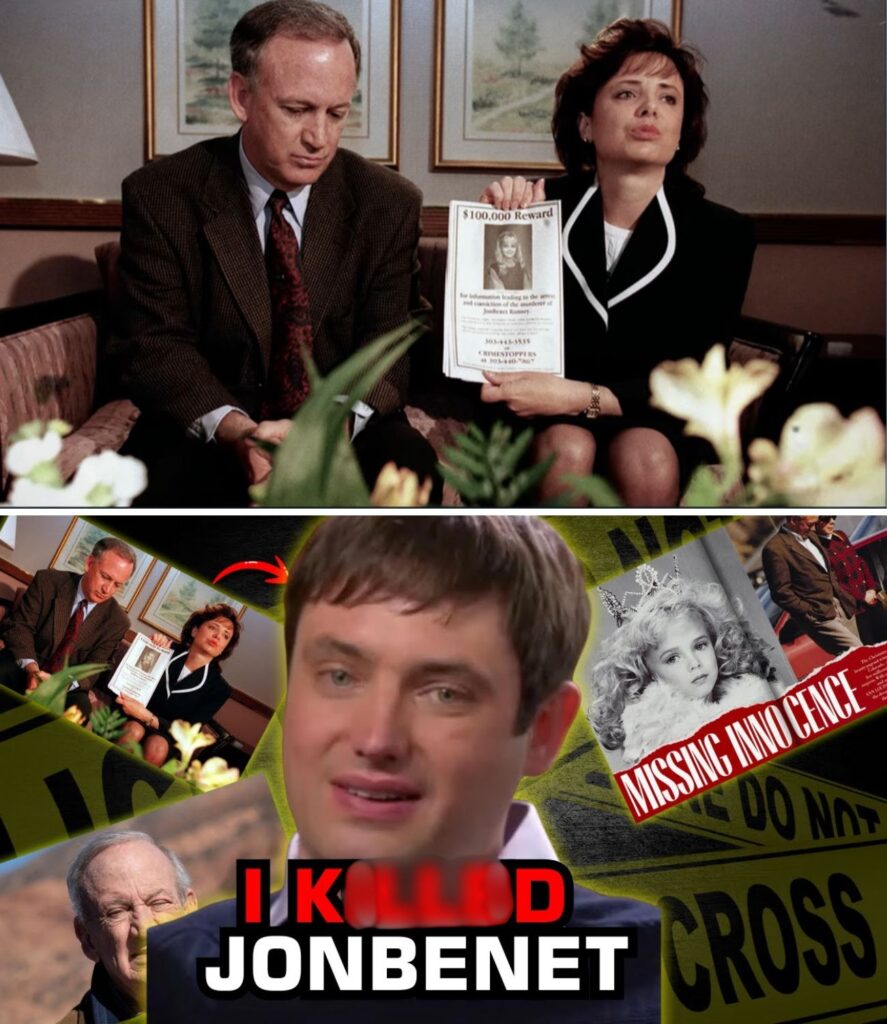
It was the morning after Christmas, 1996, in Boulder, Colorado—a day that should have been filled with leftover turkey, new toys, and the quiet contentment of the holidays. But inside the sprawling Tudor mansion on 15th Street, a nightmare was unfolding that would grip the nation for nearly three decades. The image of six-year-old JonBenét Ramsey, a beauty queen with a megawatt smile, became the heartbreaking face of an American tragedy. For 28 years, the public has been divided, pointing fingers at her parents, her brother, or a phantom intruder. But now, in a stunning turn of events that feels ripped from a movie script, advanced DNA technology—the same kind that caught the Golden State Killer—has reportedly identified a “person of interest” who was never on the police radar. Buckle up, true crime junkies, because everything you thought you knew about this case is about to change.
To understand the magnitude of this bombshell, we have to go back to that freezing December morning. Patsy Ramsey, JonBenét’s mother, woke up early to prepare for a family trip to Charlevoix, Michigan. Walking down the spiral staircase, she found a three-page ransom note that would become one of the most analyzed documents in criminal history. It demanded an oddly specific $118,000—the exact amount of her husband John’s recent bonus—and warned of a “small foreign faction.” Panic ensued. The police arrived, but in a chaotic scene that would doom the investigation, the house wasn’t sealed off. Friends roamed the halls, contaminating evidence at every turn. It wasn’t until hours later that John Ramsey found his daughter’s body in the basement wine cellar, wrapped in a blanket, a crude garrote tightened around her neck.
The media frenzy that followed was unlike anything the world had ever seen. The footage of JonBenét in full pageant glitz—feathers, makeup, and costumes—played on loop on every news station, creating a jarring contrast with the gruesome details of her murder. The public was quick to judge. The Ramseys were wealthy, beautiful, and seemingly perfect, which made their fall from grace all the more consumable for a tabloid-hungry audience. Police zeroed in on the family almost immediately, driven by the belief that the ransom note was written by Patsy and the “staging” of the crime scene pointed to an inside job. For years, John and Patsy were tried in the court of public opinion, their grief compounded by accusations that they were monsters who killed their own child.
But while the world argued over handwriting analysis and pineapple bowls, a silent witness was waiting to speak: DNA. In the early days of the investigation, trace amounts of DNA from an unknown male were found mixed with JonBenét’s blood in her underwear. At the time, technology was limited, and when it didn’t match the family or anyone in the CODIS database, investigators largely brushed it off. Some even theorized it was “factory contamination,” a desperate attempt to make the evidence fit their theory that the parents were guilty. It wasn’t until 2008—two years after Patsy died of ovarian cancer—that “Touch DNA” testing on JonBenét’s long johns revealed the same unknown male profile. This was the smoking gun that finally led the District Attorney to formally exonerate the Ramsey family, acknowledging that an intruder was the only logical explanation.
Fast forward to the 2020s, and we are living in the golden age of forensic science. Enter genetic genealogy, the revolutionary technique that uses public ancestry databases to build family trees from crime scene DNA. This is the tech that is finally cracking cold cases that have sat on shelves for decades. According to new reports surfacing in a gripping 2026 documentary, investigators have quietly been using this method on the JonBenét evidence. The result? They have allegedly identified a specific male individual—a “person of interest”—who was in Boulder in 1996, has a history of property crimes, and has absolutely no connection to the Ramsey family.
This development is earth-shattering. For years, the “Ramseys Did It” (RDI) theorists have insisted that the intruder theory was a fantasy. They pointed to the locked doors, the lack of footprints in the snow, and the sheer weirdness of the ransom note as proof that no stranger could have pulled this off. But if this new DNA lead holds up, it blows those theories out of the water. We are talking about a potential suspect who is now in his late 50s or early 60s, someone who may have been prowling the neighborhood, slipping into the house unnoticed, perhaps intending to burglarize the wealthy home, only to encounter the child.
The profile of this new person of interest is chillingly consistent with what the “Intruder Did It” (IDI) camp has argued for years. Sources suggest this individual had a history of breaking into homes in the Boulder area during that time period. He wasn’t a mastermind; he was a criminal opportunist. The fact that he has no clear alibi for Christmas night 1996 is a massive red flag. Investigators are now scrambling to connect the dots—checking boot prints found in the basement against footwear he might have owned, and analyzing palm prints that were never identified. It’s a race against time and memory, trying to build a case on evidence that has degraded over nearly 30 years.
But let’s not get ahead of ourselves—having a DNA match and getting a conviction are two very different things. The prosecution faces an uphill battle that is practically vertical. The crime scene was a disaster zone. The ransom note is still a bizarre piece of the puzzle that the defense will undoubtedly use to create reasonable doubt. If this guy was a burglar, why did he write a three-page letter? Why did he use a pen and pad from inside the house? These are the questions that keep prosecutors up at night. They know they only get one shot at this. If they charge him and lose, double jeopardy applies, and he walks free forever.
The tragedy of this delay cannot be overstated. Patsy Ramsey went to her grave with half the world thinking she killed her daughter. She never got to see the apology letter from the DA, and she certainly never saw this new ray of hope. John Ramsey, now 81, has spent the last chapter of his life fighting not just for justice, but for his family’s legacy. He has been vocal about the Boulder Police Department’s initial failures, their tunnel vision, and their refusal to let go of the family-as-suspects theory until forced by science. Seeing him now, an old man still pleading for answers, is enough to break your heart.
And then there is Burke Ramsey. Poor Burke. He was just nine years old when his sister was killed, yet the internet has been cruel to him in ways that are hard to fathom. For decades, armchair detectives have dissected his childhood interviews, his awkward smiles, and his behavior at the funeral, spinning wild theories that he lashed out in a fit of rage and his parents covered it up. The 2016 CBS documentary that pushed this theory led to a massive defamation lawsuit, which was settled, but the damage to his reputation was done. If this new DNA evidence leads to an arrest, Burke will finally be vindicated, proving once and for all that he was just a child who lost his sister, not a villain in a made-for-TV movie.
The emotional toll on this family is immeasurable. Imagine living for 28 years knowing that people whisper about you in the grocery store, that blogs are written about your “guilt,” that your tragedy is someone else’s entertainment. The Ramseys were stripped of their privacy and their dignity. The media turned JonBenét into a caricature—a doll in a glass case—rather than a living, breathing child who loved her bike and her dog. This new break in the case forces us to look in the mirror and ask: Did we, the public, make this harder? Did our obsession with the “perfect murder” blind us to the reality of a dangerous predator on the loose?
The online reaction to this news has been a mix of shock, skepticism, and cautious optimism. Social media platforms like TikTok and Reddit, which have kept this case alive with endless threads and videos, are on fire. One user on X (formerly Twitter) wrote, “If this turns out to be true, I owe the Ramseys a massive apology. I was so sure it was the parents.” Another comment on the documentary video reads, “Justice delayed is justice denied, but better late than never. I hope John is still alive to see the handcuffs go on.” The shift in public sentiment is palpable. People are starting to realize that the “simple” answer—that the parents did it—might have been the lazy answer all along.
However, the skepticism is real. The Boulder Police have teased “new information” before, only for it to lead nowhere. “I’ll believe it when I see an arrest warrant,” posted a cynical user on a true crime forum. “We’ve been burned before with ‘promising leads’ that turned out to be nothing.” This caution is warranted. The DNA amount is small, and the complexities of explaining away the ransom note remain. The “small foreign faction” line is still the weirdest red herring in criminal history. Was it a distraction? Was the killer mentally unstable? Or was the note written by someone else entirely?
The legal hurdles are immense. The defense will argue that the DNA could have been transferred innocently—maybe the guy worked at a packaging plant, maybe he sneaked into a party, maybe it’s a lab error. They will tear apart the chain of custody of the underwear. They will put the Boulder Police Department on trial for their incompetence in 1996. It will be the trial of the century, overshadowing even OJ Simpson. But for the first time, the prosecution has something that isn’t just circumstantial; they have science. Science doesn’t have an agenda. Science doesn’t care about beauty pageants or wealth. It just is.
What does this mean for the future of cold cases? It’s a beacon of hope. It tells every family waiting for answers that it’s not over. If the JonBenét Ramsey case—the most contaminated, convoluted, media-saturated case in history—can be solved, then any case can be solved. It validates the power of genetic genealogy and puts every criminal who thinks they got away with it on notice: Your DNA is out there, and eventually, we will find you.
But let’s bring it back to the victim. JonBenét would be 34 years old today. She might have been a lawyer, a doctor, a mother herself. Instead, she is frozen in time at age six. The tragedy isn’t just her death; it’s the life she never got to live. This potential breakthrough is about giving her dignity back. It’s about rewriting the ending of her story from an unsolved mystery to a closed case. It’s about telling the world that you cannot hurt a child and get away with it, no matter how much time passes.
The clock is ticking. The suspect is aging. Witnesses are dying. Memories are fading. The Boulder authorities are under immense pressure to get this right. They cannot afford another mistake. If they have the guy, they need to nail the case down tight. They owe it to JonBenét. They owe it to John. They owe it to Patsy. And frankly, they owe it to a public that they misled for decades.
So, where do we go from here? We wait. We watch. And we hope that the detectives currently working the case are better than the ones who started it. We hope that the “person of interest” doesn’t slip away before justice can be served. The pieces are finally falling into place, but the puzzle isn’t finished yet.
The coming months will be critical. Will we see a press conference with the Boulder DA announcing an arrest? Will we finally see a mugshot that replaces the mental image of a “mystery monster”? The tension is palpable. This isn’t just news; it’s a reckoning. A reckoning for a police department, a media industry, and a society that may have gotten it wrong for 28 years.
What do you think? Are you ready to let go of your theories about the parents or the brother? Do you trust that genetic genealogy has found the real killer? Or is the ransom note still too weird to ignore? Drop your thoughts in the comments below. Let’s keep the conversation going, but let’s do it with respect for the victim who is at the center of it all. Justice for JonBenét is coming, and it might be closer than any of us dared to dream.
This story is developing, and you can bet we will be here to cover every twist and turn. Stay tuned, stay safe, and keep your eyes open. The truth is out there, and it’s coming for the darkness.
It is fascinating to consider the psychological profile of the suspect if this holds true. A burglar who stumbles upon a child and kills her is a terrifying thought, but it lacks the “personal” feel that so many profilers insisted upon for years. Does this mean our understanding of “staging” is flawed? Maybe criminals do strange things under pressure that don’t fit our logical models. The ransom note might just be the ramblings of a panicked man trying to buy time, rather than a calculated plot by a family member. It challenges everything we think we know about criminal psychology.
Furthermore, the “Foreign Faction” element of the note has always been the stumbling block for the Intruder Theory. Why would a burglar claim to be a foreign faction? Perhaps it was a delusion. Perhaps it was a mockery. Or perhaps, as some sleuths are now suggesting, it was a line lifted from a movie the killer had recently seen, jumbled in his adrenaline-flooded brain. The human mind is messy, and crime scenes are rarely as neat as they appear on CSI.
Let’s also talk about the “stun gun” theory. For years, Lou Smit, the legendary detective who broke from the police to support the Ramsey family, argued that marks on JonBenét’s body were consistent with a stun gun. If this new suspect had a history of using tools or weapons to subdue homeowners, that evidence might finally make sense. It was dismissed by the prosecution back then, but in light of a violent intruder, it warrants a second look. Every piece of evidence that was discarded because it didn’t fit the “parents” narrative needs to be dusted off and re-examined.
The role of the media in this new chapter will be crucial. Will they give the same airtime to the exoneration as they did to the accusation? The Ramseys were front-page news when they were suspects. Will the arrest of a random burglar get the same coverage? It should. It is the responsibility of the press to correct the record. We saw how Richard Jewell was treated in the Atlanta Olympic bombing—vilified by the media only to be proven a hero. The Ramseys are in a similar boat. The media owes them a massive debt of correction.
And what about the town of Boulder? The murder cast a long shadow over that community. It changed the way people locked their doors. It ended the era of innocence for that quiet college town. A resolution would bring closure not just to the family, but to the entire city. It would lift the stigma of “incompetence” that has plagued the police department, assuming they can successfully prosecute the case now. It’s a chance for redemption for everyone involved.
As we digest this news, it’s important to remember the power of persistence. John Ramsey never gave up. He spent his fortune and his golden years chasing leads, hiring private investigators, and keeping his daughter’s name in the press for the right reasons. His love for his daughter is the engine that kept this case from becoming just another cold file in a basement box. It is a testament to a father’s love that we are even talking about a breakthrough today.
The technology involved here—genetic genealogy—is truly a marvel. It works by taking the DNA profile from the crime scene (which is often degraded or incomplete) and uploading it to databases like GEDmatch or FamilyTreeDNA (with permission). It then looks for people who share DNA segments—cousins, second cousins, even further out. Genealogists then build “reverse family trees” to fill in the blanks until they land on a candidate who fits the age, location, and gender profile. It is tedious, brilliant work. It bypasses the need for the suspect to have been arrested before. He could have been a ghost to the system, but his third cousin’s decision to take a DNA test to find their heritage became the key to unlocking the truth.
This method raises privacy concerns for some, but for the families of murder victims, it is a godsend. It is the only tool left when all other leads have dried up. In the case of JonBenét, where the killer left his genetic calling card on her clothing, it is the perfect application of the science. It feels almost like destiny that the technology matured just in time to solve the most famous cold case of our generation.
We must also prepare ourselves for the possibility that the “person of interest” is already deceased. If that is the case, there will be no trial, no verdict, and no prison sentence. But there will still be truth. Knowing the name, seeing the face, and understanding the “why” is a form of justice in itself. It would stop the speculation. It would end the harassment of the family. It would close the book. While we all want to see a perpetrator in handcuffs, the truth is the ultimate goal.
So, as we wait for the next official update, take a moment to reflect on the gravity of this. We are watching history unfold. The JonBenét Ramsey case has been a cultural touchstone for 28 years. It has inspired books, movies, podcasts, and endless debates. To see it potentially resolved in our lifetime is surreal. It reminds us that no secret can stay buried forever, not when science is shining a light into the darkest corners of the past.
For those of you who have followed this case since 1996, this is the moment you’ve been waiting for. For those who are new to it, you are witnessing the climax of a decades-long mystery. Whatever the outcome, one thing is certain: The story of JonBenét Ramsey is not over yet. The final chapter is being written right now, and the ink is DNA.
Stay tuned to this channel and your news feeds. We will be updating this story as soon as more information becomes available. Until then, keep asking questions, keep demanding answers, and never forget the little girl in the tiara who captured the world’s heart and broke it all at the same time. Justice is coming. We can feel it.