
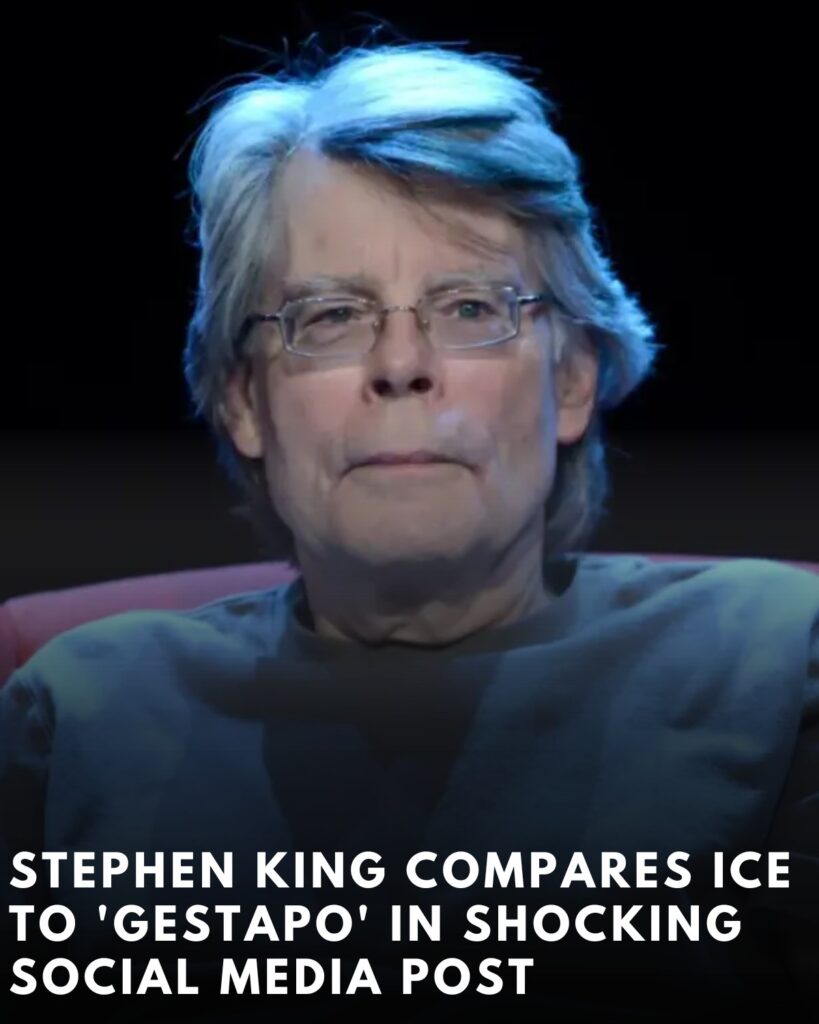
Stephen King has sparked a fresh political storm in the United States after posting a blunt condemnation of Immigration and Customs Enforcement, using a term historically associated with Nazi Germany’s secret police.
“ICE is the American Gestapo,” the author wrote on X, prompting a wave of reactions that quickly spread far beyond the usual circles of literary debate.
King’s remark landed amid heightened tensions over federal immigration enforcement and the use of heavily armed, masked officers during operations and protests, particularly in Minneapolis, which has become a focal point for scrutiny after two fatal shootings involving federal immigration officers in January.
In one of those cases, Alex Pretti, described by friends and family as an intensive care nurse and a US Army veteran, was killed on 24 January during what authorities said was a confrontation near a protest. Pretti’s death was followed by sharply diverging accounts of what happened, with federal officials and local leaders disputing the circumstances and the broader context of enforcement activity in the city.
The earlier fatal shooting involved Renee Nicole Good, a mother of three, who was shot by an ICE agent on 7 January while sitting in her car in Minneapolis, according to local reporting and official statements. Her death quickly became a rallying point for critics who say federal agents are operating with excessive force and inadequate transparency.
King’s post drew attention in part because it used “Gestapo,” a word that carries specific historical meaning. The Gestapo was the secret state police of Nazi Germany, widely associated with political repression, surveillance and the violent enforcement of state power. Historians and museums have long warned against casual analogies, even as the term has periodically reappeared in political rhetoric as a shorthand for authoritarian policing.
Supporters of King argued that the comparison reflected what they see as an erosion of civil liberties and a dangerous militarisation of law enforcement. Critics said the language was inflammatory and historically inappropriate. The row is the latest example of a long-running pattern in US public life, where prominent cultural figures weigh in on politics, often drawing applause from some corners and backlash from others.
King, who has spent decades as one of America’s best-known writers, has also been outspoken politically for years, frequently using social media to comment on elections, public officials and national controversies. His latest post was short, but the phrase was potent enough to become a headline in its own right.
The immediate backdrop was a series of events in Minneapolis that have drawn national attention. According to reporting and official accounts, the city has seen large protests connected to immigration enforcement actions and the presence of federal agents. The death of Good in early January prompted public anger and calls for answers about why an ICE agent fired into a vehicle. Her name was invoked repeatedly in subsequent demonstrations and political speeches.
In a separate incident later in the month, Pretti was killed during an encounter involving federal agents. Federal authorities characterised the shooting as justified, while local officials and civil rights advocates demanded independent scrutiny and questioned the conduct of agents on the ground. The case became even more contentious as accounts emerged about what Pretti was holding at the moment he was shot, and how quickly the confrontation escalated.
The debate has also drawn in prominent voices outside politics. In New Jersey on 17 January, the musician Bruce Springsteen addressed the situation in Minnesota during a concert introduction, describing a country under pressure and urging audiences to speak out if they “believe in democracy and liberty” and if they oppose “heavily armed masked federal troops invading an American city”.
Springsteen’s remarks, delivered while dedicating a song to Good, underscored how rapidly the Minneapolis shootings have been absorbed into wider arguments over federal power and the treatment of immigrants.
Minnesota’s governor, Tim Walz, has also used striking language about the federal presence in the state, accusing the administration of behaviour that he and other critics say resembles secret policing, according to reporting cited by UNILAD.
UNILAD’s coverage of King’s post linked his wording to a broader pattern of public figures using historical analogies to condemn what they describe as intimidation or unlawful tactics by masked officers. The outlet also highlighted the depth of online reaction, including thousands of responses and reposts that reflected the polarised mood of the debate.

The controversy arrives at a moment when immigration enforcement, protests, and public safety are colliding more frequently, and when video clips and eyewitness accounts can shape public perception long before investigations are complete. In the Minneapolis cases, questions about the sequence of events, the conduct of officers, and the decision-making that led to lethal force have been central, as have competing claims by authorities and critics about whether the shootings were unavoidable or preventable.
For King, the backlash and support are not new. His public persona has increasingly included political commentary alongside his fiction, and his posts routinely travel far beyond his core readership. What made this latest intervention particularly combustible was the historical weight of the word he chose, and the fact that it echoed language now being used by other high-profile voices focused on Minneapolis and federal immigration enforcement.
Whether the term “Gestapo” remains in circulation in the coming weeks may depend on what investigators ultimately establish about the Minneapolis shootings, and whether further details emerge that either reinforce or undermine accusations of excessive force. For now, King’s comment has become a lightning rod, crystallising a national argument about the limits of state power, the conduct of federal agents, and how Americans talk about authoritarianism, history and fear in the middle of a live, unfolding dispute.