For a generation of television viewers, the comedic alchemy of Three’s Company remains the gold standard of the sitcom era. The series anchored itself on a lightning-in-a-bottle chemistry between its lead trio, a bond that felt as genuine as it was hilarious. While the industry has since mourned the loss of two of its brightest luminaries—John Ritter and Suzanne Somers—their comedic legacies have found a second life. In the age of streaming syndication and social media algorithms, iconic clips are being unearthed for a new audience, stirring up a complex cocktail of nostalgia, adoration, and, increasingly, modern scrutiny.
Recently, a specific segment from the show’s fifth season has gone viral, igniting a firestorm of emotional responses. To understand why this particular moment is trending nearly half a century later, one must first look at the delicate house of cards upon which the show was built. Three’s Company thrived on a relentless engine of slapstick and farce: two single women, Janet Wood (Joyce DeWitt) and Chrissy Snow (Suzanne Somers), sharing a Santa Monica apartment with a bumbling culinary student, Jack Tripper (Ritter). To appease their conservative landlords, Jack famously posed as a gay man—a premise that served as a springboard for endless double entendres and frantic misunderstandings.
From 1977 to 1983, the show was an immovable object in the Nielsen top ten, beloved by audiences for its breezy, high-energy charm. Yet, four decades after the final curtain call, it is proving that it still possesses the power to polarize.

The Anatomy of “A Crowded Romance”
The episode currently under the digital microscope is “A Crowded Romance,” the fifth installment of Season 5 and the 83rd episode of the series. Originally airing on December 2, 1980, the plot is quintessential Three’s Company chaos. Larry (Richard Kline) believes he has found “the one” and enlists Janet to send her flowers; Janet, in turn, asks Jack to deliver them. Upon meeting the mystery woman, Jack decides she is “the one” for him as well. The ensuing love triangle—fueled by mutual ignorance and Jack’s attempt to juggle the girl and a new job Larry helped him secure—is a masterclass in the show’s signature miscommunication.
However, the episode’s fascination for modern viewers lies less in its plot and more in its production history. “A Crowded Romance” was actually the first episode filmed for Season 5, despite its later air date. For the observant fan, there is a glaring omission: Suzanne Somers is entirely absent from the frame.
While many might assume this was the direct result of her infamous contract dispute, the initial reason was far more logistical. The 1980 Screen Actors Guild and AFTRA strike had effectively shuttered Hollywood for the summer, pushing production from July to October. During this hiatus, Somers had committed to a high-profile stage residency at the MGM Grand in Las Vegas. When the strike broke, the filming schedule clashed with her Vegas dates, forcing writers to exclude her from the script.
The “twist” of fate, however, is that by the time the episode finally hit the airwaves in December, Somers’ real-life battle for pay equity had begun. She had famously demanded a 500 percent raise—from $30,000 to $150,000 per week—to match the salary of her male co-star, John Ritter. The producers’ refusal and her subsequent firing marked the beginning of a cold war on set that saw her relegated to brief, isolated phone-in scenes before her total exit. As Somers told The New York Times in 1981, “I’ve been playing what I think is one of the best dumb blondes that’s ever been done… I did it so well that everyone thought I really was a dumb blonde.”
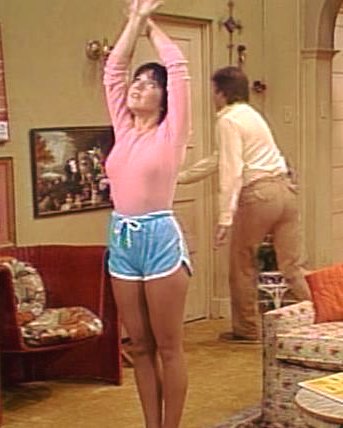
With Somers sidelined, Joyce DeWitt took center stage in “A Crowded Romance,” donning an outfit that has since become synonymous with the character: a pink blouse paired with iconic blue shorts. The episode highlights the undeniable, grounded chemistry between DeWitt and Ritter, the two “anchors” who kept the show’s ship upright during its most turbulent years.
The scene that has set TikTok and Instagram ablaze begins innocently enough. Janet encourages Jack to engage in some morning calisthenics. Jack, in classic Tripper fashion, retorts that he has already completed “20 hair combs and two sets of teeth brushing,” joking that he doesn’t want to “overtrain.”
Moments later, as he exits the room, Jack gives Janet a playful, physical nudge on her backside. Janet’s scripted reaction—”I hate when you do that”—was played for laughs in 1980. In 2026, the reaction is far more divided.
To a segment of the audience, the gesture is a jarring reminder of a different era. One TikTok user noted, “I haven’t watched this since I was a kid, never realized how inappropriate Jack was!” Others have taken a far more aggressive stance, with comments labeling the character’s behavior as “predatory.” Conversely, a large swath of fans views the criticism as an overreach of “cancel culture” into vintage media. “It was funny stupid humor! Unfortunately gone today,” one user lamented, reflecting a deep nostalgia for the era of the “cheeky” sitcom.
This cultural friction highlights the massive shift in societal standards regarding workplace respect and gender dynamics. What was once considered harmless, fraternal slapstick in a 1970s writers’ room is now viewed through the lens of modern consent and professional boundaries.
The Great Haircut Conspiracy
While some fans debate the ethics of the “slap,” others have focused on a far more lighthearted observation: Jack and Janet appear to be sharing more than just an apartment—they seem to be sharing a hairdresser.
In Season 5, the physical resemblance between Ritter and DeWitt’s hairstyles reached a peak, sparking a long-running online debate about Janet’s evolving look. Throughout the series, DeWitt’s hair was a trendsetter, moving from the sleek, thick “Dorothy Hamill” wedge of the early years to the thinner, curlier textures of later seasons.
The “magic” behind Janet’s perky, spiky Season 5 look was the work of New York freelance stylist Harry King. King crafted a wash-and-wear style using short, even layers to provide a light, airy volume, balanced by a bit of extra length at the nape of the neck. It was a look that defined the late-70s zeitgeist and sent thousands of women to salons requesting “The Janet.”
The “Set Top” Mystery: Blooper or Background?
Finally, the digital resurgence of “A Crowded Romance” has reinvigorated the amateur sleuths of the “bloopers” community. A persistent claim has circulated that the top of the studio set is visible during a scene where Jack discusses his new job.
In the world of multi-camera sitcoms, it wasn’t uncommon for a boom mic or a lighting rail to peek into the top of a frame, especially in the era of 4:3 aspect ratios. However, veteran fans have stepped in to debunk this particular “error.” What modern viewers perceive as a gap in the set is actually a piece of period-accurate, albeit dated, trim. These retro design elements, while perhaps looking like structural set-ends to the untrained eye, were simply part of the 1980 aesthetic.
Whether the conversation is centered on the nuances of Janet’s hair, the technicalities of the set design, or the evolving definitions of appropriate humor, one thing is certain: Three’s Company remains a living, breathing part of the cultural conversation. It continues to provoke, entertain, and challenge us, proving that true “classic” status isn’t just about being remembered—it’s about being debated.
