
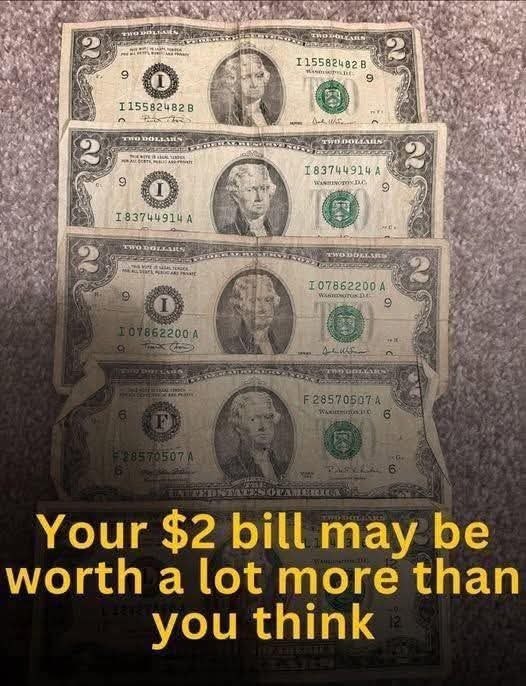
For many years, the American $2 bill has occupied an unusual place in everyday currency. Some people viewed it as uncommon or even unlucky, while others believed it was no longer in circulation. In reality, the $2 bill remains legal tender in the United States. Although it is printed in smaller quantities compared to other denominations, it continues to be issued by the U.S. Treasury and can still be used like any other bill.
The $2 bill was never discontinued; it simply became less common in daily transactions. Because retailers and banks often stock fewer of them, many people rarely encounter one. This limited visibility has contributed to the perception that it is rare. As a result, some individuals choose to keep $2 bills as keepsakes rather than spend them, which further reduces how often they appear in circulation.
Most modern $2 bills, particularly those printed after 1976, generally carry a value close to their face amount unless they are in exceptional condition or have distinctive characteristics. Collectors may look for unique serial numbers, such as repeating digits, low serial numbers, or specific number patterns. Crisp, uncirculated bills are typically more desirable to collectors than those showing heavy wear.
Older $2 bills, especially those issued in the late 19th and early 20th centuries, can hold higher collector value depending on condition, rarity, and seal color. Printing errors or limited production runs may also increase interest among currency enthusiasts. If you come across a $2 bill, it may be worthwhile to review its year, overall condition, seal details, and serial number before deciding whether to spend it, as certain examples can attract collector interest.