
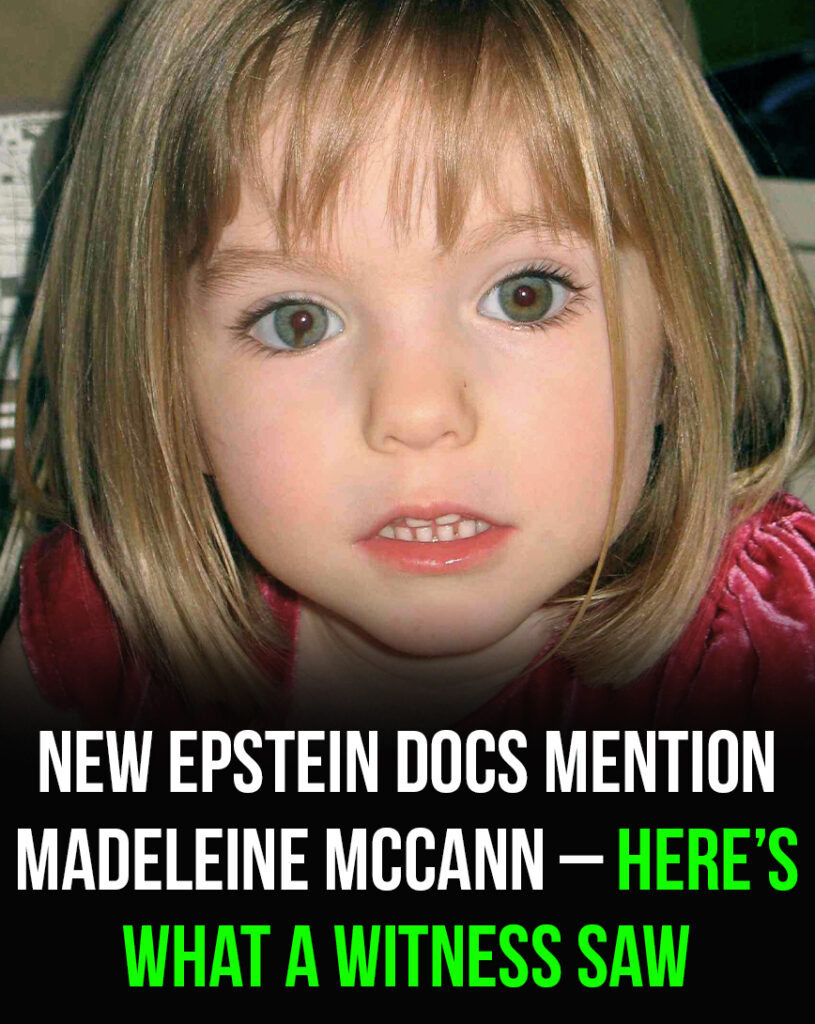
Buried within the labyrinthine release of the “Epstein Files”—millions of pages unsealed by the U.S. Department of Justice—is a 2009 witness report that has reignited one of the most haunting mysteries of the 21st century. The document describes a sighting of a young girl who “looked like Madeleine McCann,” allegedly accompanied by a woman who bore a striking resemblance to Ghislaine Maxwell.
Madeleine McCann was just three years old when she vanished on May 3, 2007, during a family vacation at the Ocean Club resort in Praia da Luz, Portugal. Her parents, Kate and Gerry McCann, had been dining with friends just 100 yards from the apartment where Madeleine and her two-year-old twin siblings slept. By the time Kate returned for a routine check, the bedroom window was open and Madeleine was gone.
The disappearance triggered what became “the most heavily reported missing-person case in modern history,” mobilizing international police resources and years of investigative leads. Yet, nearly 19 years later, the child has never been found.
The Unidentified Witness Statement
The unexpected emergence of Madeleine’s name in the context of Jeffrey Epstein’s prosecution and Maxwell’s 2021 sex-trafficking conviction stems from a single witness statement dated July 7, 2020.
The report, submitted to the FBI’s National Threat Operations Center (NTOC) by an unidentified individual in the UK, details a quiet Sunday in September 2009. The witness claims to have encountered a trio—a man walking significantly ahead of a woman and a young girl—on a deserted road.
“When I got up close to the girl I noticed she looked like Madeline McCann,” the statement reads. “The woman was trying to hurry her along and seemed agitated that I was there. The little girl held her hand over her right eye the whole time we were walking along. She kept on turning round to look at me.”
The detail regarding the child’s right eye has drawn intense scrutiny. Madeleine was famously known to have coloboma, a rare eye condition characterized by a keyhole-shaped smudge in the pupil. According to medical experts, this condition can cause light sensitivity, potentially explaining why the child in the report was shielding her eye.
The witness added: “Didn’t think about it for years till [I] saw the FB post about [Ghislaine] Maxwell and the theory of her taking Madeline McCann. The woman I saw looked just like Ghislaine Maxwell.”
The “Posh Spice” Connection
The unearthing of this report has revived interest in an “e-fit” (electronic facial identification technique) commissioned by the McCann family’s private investigators in 2009. At the time, British media described the suspect as a “Victoria Beckham lookalike”—a woman between 30 and 35 with a short, black hairstyle.
Notably, in 2009, both the pop icon and Ghislaine Maxwell favored nearly identical short, dark haircuts. While this lead originally placed a suspect in Barcelona just days after Madeleine’s disappearance, no law enforcement agency has ever formally linked the composite image to Maxwell, nor have officials suggested the lead fundamentally altered the course of the investigation.
A Warning on Document Authenticity
Despite the viral nature of this discovery, the Department of Justice has issued a stern caveat regarding the massive document trove. Officials emphasize that the unsealed files contain every tip, lead, and submission sent to the FBI by the public—regardless of its veracity.
“This production may include fake or falsely submitted images, documents or videos, as everything that was sent to the FBI by the public was included,” the DOJ stressed in a statement.
Law enforcement agencies in both the U.S. and the UK maintain that this isolated account does not constitute verified evidence. As of now, the report has not triggered new investigative action, nor has any official agency substantiated a link between the McCann case and the crimes of Epstein and Maxwell.
The document remains a single, unverified thread in a case defined by thousands of dead ends. Whether it represents a missed opportunity or merely the byproduct of public speculation remains a matter of intense debate.