
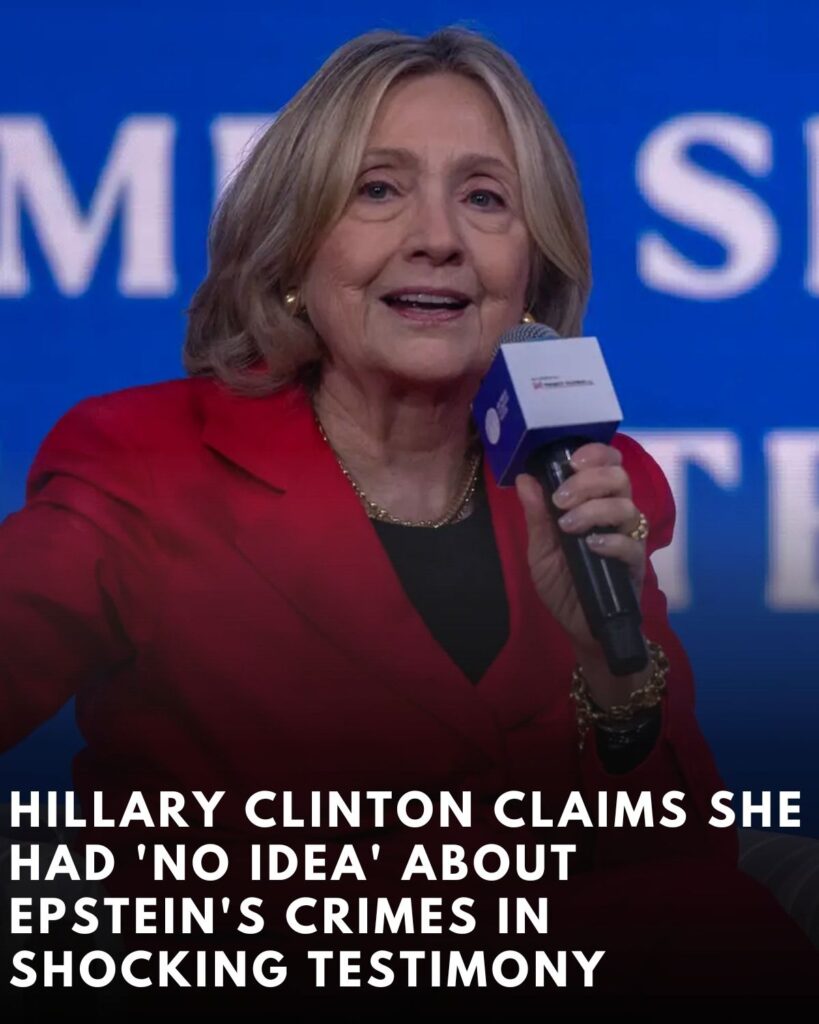
Former US Secretary of State Hillary Clinton told a congressional committee on Thursday that she had no information about the crimes of Jeffrey Epstein or his longtime associate Ghislaine Maxwell, and said she did not recall ever encountering the disgraced financier, as Republicans intensified a high-profile House investigation that will also include testimony from former President Bill Clinton.
Clinton appeared for a closed-door deposition before the Republican-led House Oversight Committee in Chappaqua, New York, after the panel issued subpoenas as part of what it describes as an effort to gather information about Epstein’s network and the release of material connected to the late financier. Epstein, a convicted sex offender, died by suicide in jail in 2019 while awaiting trial on federal sex-trafficking charges.
In an opening statement that Clinton shared on X, she said the committee had compelled her testimony despite, she said, already being aware she could not assist their inquiry. “The Committee justified its subpoena to me based on its assumption that I have information regarding the investigations into the criminal activities of Jeffrey Epstein and Ghislaine Maxwell. Let me be as clear as I can. I do not,” she said. “As I stated in my sworn declaration on January 13, I had no idea about their criminal activities. I do not recall ever encountering Mr. Epstein.”
Clinton, the 2016 Democratic presidential nominee and a former US senator and first lady, also accused the committee of using her testimony to shift attention away from President Donald Trump, arguing that the panel’s focus should be elsewhere. In the same statement, she said: “But that’s not happening. Instead, you have compelled me to testify, fully aware that I have no knowledge that would assist your investigation, in order to distract attention from President Trump’s actions and to cover them up despite legitimate calls for answers.”
Reuters reported that, in her prepared testimony, Clinton accused the panel of trying to shift focus away from Trump’s ties to Epstein, and noted that Trump’s administration has “gutted” a State Department office focused on international sex trafficking. Clinton has long been associated with anti-trafficking initiatives, including work during her time as secretary of state, and she used the opening statement to describe herself as “horrified” by Epstein and Maxwell’s crimes while outlining her broader advocacy for women and girls, including survivors of human trafficking, forced labour and sexual slavery.
After the deposition, Clinton spoke to reporters outside the venue, as members of the public gathered nearby. Bill Clinton is scheduled to appear before the committee on Friday, also behind closed doors. A committee spokesperson has said video and transcripts from the depositions will be released.
Hillary Clinton said her husband would testify that many people who had contact with Epstein before his 2008 criminal pleas did not know about the sex-trafficking. “The vast majority” of people who had contact with Epstein before that point “did not know” about the sex trafficking, she said, adding: “That is exactly what my husband will testify to tomorrow,” according to Reuters.
The committee’s chairman, Republican Congressman James Comer of Kentucky, rejected Clinton’s suggestion that the inquiry was politically motivated. He has said the committee is seeking answers rather than making accusations. Reuters quoted Comer as saying: “No one is accusing at this moment the Clintons of any wrongdoing but we do have a lot of questions.”
Comer also dismissed calls for Trump to appear before the committee. Speaking to reporters after Clinton’s testimony, he said: “President Trump has answered hundreds if not thousands of questions from you all about Epstein and I think he’s been very transparent in releasing the documents,” Reuters reported.
The Clintons initially resisted appearing, but agreed to testify after lawmakers moved towards holding them in contempt of Congress. Their lawyers had previously said the couple had already provided the “limited information” they had about Epstein and Maxwell, and criticised the subpoenas as partisan. The committee has said the depositions are part of its broader effort to understand who interacted with Epstein and what was known about his conduct, particularly as previously sealed records and documents have continued to attract political and public scrutiny.
Clinton’s testimony took place amid renewed debate in Washington over so-called “Epstein files”, a term often used online and in political messaging to describe material tied to investigations, court proceedings, and document releases connected to Epstein and Maxwell. Clinton’s name, along with the names of many other public figures, has appeared in various records linked to the case. The existence of a name in such documents does not itself establish wrongdoing, and neither Hillary Clinton nor Bill Clinton has been accused of crimes related to Epstein or Maxwell.
In her public remarks, Clinton maintained that she had no information on the crimes at the centre of the committee’s inquiry, and portrayed the subpoena as part of a larger political strategy in which, she said, Republicans were seeking to shield Trump from scrutiny. The former secretary of state has in recent days accused the administration of a “cover-up” related to the release of Epstein-related material, a claim she repeated in her opening statement.
Time reported that proceedings during Clinton’s deposition were briefly paused when it became apparent that a photograph from the closed-door session had been shared on social media. The image showed Clinton seated at a table with individuals on either side. The conservative commentator Benny Johnson posted the photo and said Republican Congresswoman Lauren Boebert of Colorado had shared it with him, according to Time.
The episode underscored the political intensity surrounding the inquiry and the broader Epstein-related discourse, which has repeatedly spilled across social media platforms, mixing official legal records with partisan claims and online speculation. Clinton’s team and Democratic allies have argued that the committee’s focus on her and her husband is misplaced, while Republicans insist they are seeking testimony from prominent figures whose names have surfaced in records tied to Epstein.
Epstein, once a well-connected financier, pleaded guilty in 2008 in Florida to solicitation of prostitution involving a minor and served a jail term under a controversial agreement. He was later arrested in 2019 on federal charges alleging he ran a sex-trafficking operation involving underage girls. He died in custody before trial. Maxwell, a longtime associate of Epstein, was later convicted in federal court for her role in recruiting and grooming underage girls for Epstein’s abuse.
The House Oversight investigation has drawn attention because of the breadth of names associated with Epstein in photos, flight logs, address books and court filings. Bill Clinton has previously been photographed with Epstein, and his name has appeared in records reviewed in prior reporting. Representatives for Bill Clinton have said in the past that he cut ties with Epstein well before Epstein’s 2019 arrest and was unaware of Epstein’s crimes, a position consistent with Hillary Clinton’s statement on Thursday about what her husband is expected to tell lawmakers.
For Hillary Clinton, the deposition also brought fresh focus to a political figure who, despite stepping back from electoral politics after her 2016 defeat, remains a frequent target of partisan attacks and a prominent voice within Democratic circles. Her public stance after the deposition was that the committee had extracted hours of testimony despite, she said, her repeated insistence that she could provide no relevant information.
The committee is expected to continue releasing material from the depositions, including transcripts, once reviewed for security and procedural issues. With Bill Clinton due to appear next, Republicans are likely to face renewed questions over whether their inquiry will broaden to include other current or former officials, and whether the investigation will produce substantive findings beyond the testimony already given that, by Clinton’s account, contained no new information about Epstein or Maxwell’s criminal activity.