
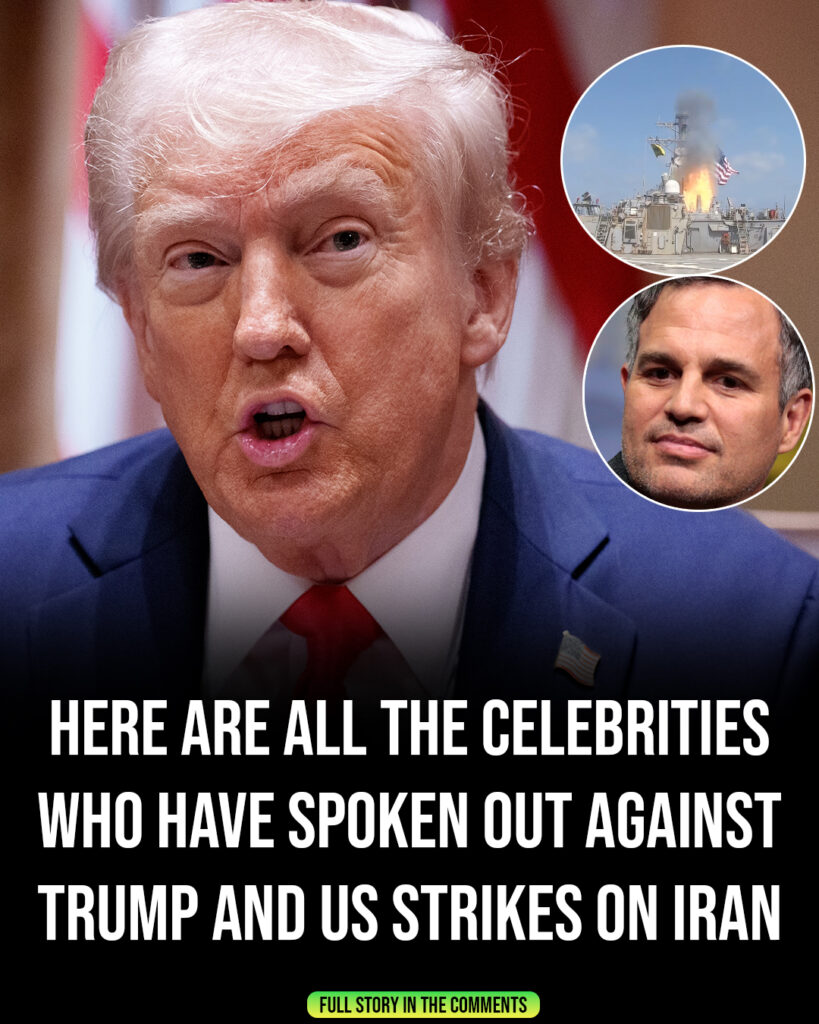
A growing legion of celebrities is publicly breaking ranks with the administration following the U.S.-Israeli airstrikes on Iran. In a wave of digital dissent, high-profile figures are accusing President Donald Trump of hypocrisy and recklessness, arguing that the country is being dragged into a “dangerous and unnecessary” war under the guise of national security.
As the conflict between Tehran and Washington intensifies and the death toll—both military and civilian—continues to climb, the criticism from entertainers, novelists, and public figures is reflecting a broader societal anxiety. For many in the creative community, the current strikes represent a total abandonment of the President’s campaign-era promise to end “forever wars.”

Jack White: “The Board of Peace”
Among the most acerbic critics is Jack White. The former frontman of The White Stripes utilized Instagram to launch a scathing critique, not only of the military strategy but of the aesthetic through which the war is being marketed to the American public.
White ridiculed the optics of the Commander-in-Chief announcing combat operations while maintaining a carefully curated “populist” persona. “Don’t you love seeing him declare war on a country while wearing a trucker hat that says ‘USA’ on it?” White wrote. He sarcastically labeled Trump the head of a “Board of Peace,” adding: “Venezuela, Greenland, Iran, Cuba — what’s the difference right? Don Jr. and Barron won’t have to fight or die, just other people’s children, so… invade and bomb away!” White concluded his tirade with a sharp jab at the President’s long-standing desire for international validation: “Can you believe Donny hasn’t received a real Nobel Peace Prize yet? Unfair!”
Rosie O’Donnell and the “Candidate of Peace”
Comedian Rosie O’Donnell, a frequent and long-term foil to the President, accused the administration of fundamental dishonesty. O’Donnell, who famously relocated to Ireland at the start of the Trump presidency, posted screenshots of past administration statements where Trump claimed to be “the candidate of peace.”
“He lies only and always #impeachtrump,” she wrote. O’Donnell has maintained her stance that she will only return to the United States “when it’s safe for all citizens to have equal rights,” framing the Iranian conflict as an extension of an unsafe and volatile domestic environment.

Constitutional Warnings and Historical Context
The backlash has also moved into the realm of constitutional law. Legendary horror author Stephen King reminded his millions of followers that, under Article I, Section 8 of the U.S. Constitution, the authority to declare war rests solely with Congress—not the Executive Branch.
King ended his post with a blunt call for impeachment. He also pivoted to a personal critique of the President’s own military history: “This is the man who was too chickenshit to fight in Vietnam. His daddy got him out of it,” King wrote. This refers to the five deferments the President received during the Vietnam War, a point of contention that critics frequently revive when the President initiates kinetic military action.
The “Wag the Dog” Theory: Distraction or Strategy?
Actor John Cusack took a more cynical, geopolitical view, suggesting that the conflict is a strategic distraction from domestic legal troubles. Taking to X (formerly Twitter), Cusack characterized the strikes as a “wag the dog war.”
“Trump starts a wag the dog war – to distract from Epstein and to do Netanyahu’s bidding – who’s lobbied for this for over 30 years – Had enough yet?” Cusack wrote. He has previously been uncompromising in his rhetoric, describing the President as an “evil f*** who grinds our faces in it every day.”
This sentiment was echoed by actor Mark Ruffalo, who pointed to the influence of the President’s inner circle. Posting an article regarding lead negotiator Jared Kushner, Ruffalo wrote simply: “He was sent to make sure we went to war.”

The Great Divide: A Nation at a Crossroads
The celebrity outcry highlights a fundamental fracture in American public opinion. Supporters of the administration argue that the strikes were a clinical necessity to eliminate a “long-standing threat” and protect vital American interests in the Persian Gulf. Conversely, the critics featured here argue that the move has dismantled years of delicate diplomacy, violated international law, and risks igniting a global conflagration.
As lawmakers in D.C. remain split and world leaders urge a restraint that seems increasingly unlikely, the debate over the morality and legality of “Operation Epic Fury” is only beginning.
Was the United States right to initiate these strikes, or has the administration crossed a line that cannot be uncrossed? As the regional theater of war expands, would you like me to analyze the specific congressional reactions to these Article I concerns, or perhaps examine the current status of the “Epstein files” that critics like John Cusack claim are being obscured by the fog of war?