

A resurfaced comedy clip featuring Robin Williams has recently captured widespread attention online, prompting audiences to revisit his sharp wit and remarkable ability to comment on public figures with humor and insight.
The clip, originally recorded during a stand-up performance in 2012, has sparked renewed discussion because of its pointed jokes about Donald Trump, years before Trump entered political office.
Robin Williams, who passed away in 2014 at the age of 63, remains one of the most beloved entertainers in modern history.
Known for his rapid-fire improvisation, emotional depth, and boundless energy, he built a career that spanned stand-up comedy, film, and voice acting. His work earned critical acclaim and numerous awards, including an Academy Award, multiple Golden Globe Awards, and several Grammy Awards.
While many younger audiences recognize him for his roles in family-friendly films and heartfelt dramas, Williams never strayed far from his roots in stand-up comedy.
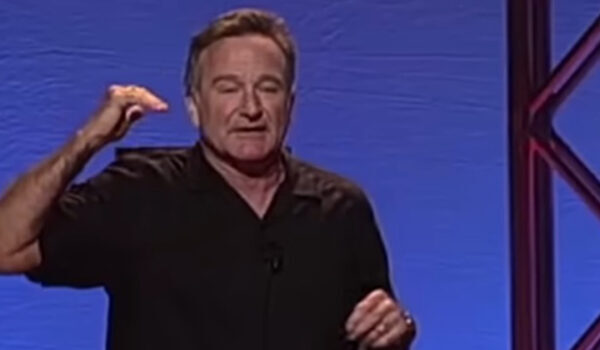
It was on stage where he expressed his most unfiltered observations about society, culture, and public personalities. His comedic style often blended absurd humor with sharp social commentary.
The resurfaced clip originates from a 2012 stand-up routine, a time when Donald Trump was primarily known as a real estate developer and television personality.
Trump’s presence in popular culture was largely tied to his business ventures and his role on reality television, rather than politics.
In the performance, Williams humorously describes a visit to Atlantic City, painting a chaotic and exaggerated picture of the environment.
He compares the experience to a surreal version of a well-known fantasy setting, using vivid imagery to entertain the audience while setting up his comedic observations.
It is within this context that Williams introduces Trump into the routine. He jokes that Trump resembles a powerful yet theatrical figure, likening him to a larger-than-life character who controls vast properties and wealth. The humor stems from exaggerating Trump’s public persona at the time.
Williams also pokes fun at Trump’s business style, joking about his tendency to brand properties with his own name. He humorously suggests that Trump plays a real-life version of a board game involving properties, highlighting the scale and visibility of his real estate ventures.
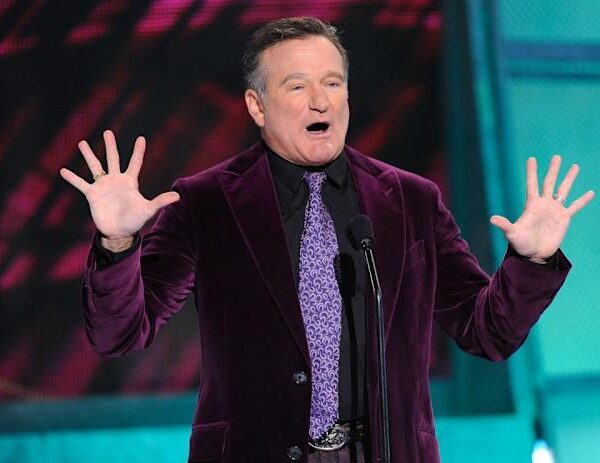
At the time of the joke, Trump had been associated with several high-profile casino properties in Atlantic City. Some of these businesses later faced financial difficulties, including bankruptcies and restructuring, which were widely reported in financial and business news.
Williams’s routine continues with commentary on Trump’s involvement in beauty pageants. Trump had owned major pageant organizations, including Miss Universe, Miss USA, and Miss Teen USA, which were part of his broader business portfolio for many years.
In one of the more provocative parts of the routine, Williams draws a comparison meant to highlight perceived contradictions. The joke references a well-known sports figure who had faced legal consequences for animal cruelty, using the comparison to emphasize the comedic point.
It is important to note that Williams’s humor often relied on pushing boundaries and making bold, sometimes controversial comparisons. This approach was a hallmark of his stand-up style, where he sought to provoke thought as well as laughter.
The routine also touches on public comments Trump had made in media interviews, which had attracted attention and criticism at the time. Williams incorporates these elements into his performance, framing them in a comedic light for his audience.
Another memorable part of the clip involves Williams joking about Trump’s distinctive hairstyle. This aspect of Trump’s appearance had long been a subject of public curiosity and humor, making it a natural target for comedic exaggeration.
Williams uses physical comedy to enhance the joke, mimicking the movement of hair and creating a visual gag that adds to the humor. His ability to combine verbal wit with physical performance was one of his defining strengths as a comedian.
The resurfaced clip has gone viral across social media platforms, where users have shared and commented on the performance. Many viewers describe the jokes as surprisingly relevant, even though they were made years before Trump’s presidency.
Some commenters have interpreted the routine as “prophetic,” suggesting that Williams had an unusually perceptive understanding of public figures. However, others note that comedians often draw from observable traits, making such insights part of their craft.
It is worth emphasizing that Williams’s jokes were based on Trump’s public image at the time. As a comedian, Williams was responding to widely known aspects of Trump’s persona rather than predicting future events.
The renewed interest in this clip also highlights the enduring appeal of Williams’s comedy. Even years after his passing, his work continues to resonate with audiences and spark conversation across different generations.
Williams’s legacy extends far beyond individual jokes or performances. He was known for his compassion, generosity, and ability to connect with people through humor. His performances often balanced comedy with moments of genuine emotional depth.
In addition to his stand-up work, Williams achieved critical acclaim in film. He delivered powerful performances in dramatic roles, showcasing a range that few comedians have successfully demonstrated.
His voice acting also left a lasting impact, particularly in animated films where his energetic and improvisational style brought characters to life in memorable ways. These performances introduced him to younger audiences worldwide.
The viral resurgence of the 2012 clip serves as a reminder of Williams’s ability to capture cultural moments through comedy. His observations often reflected broader societal themes, making his humor both entertaining and thought-provoking.
Social media has played a significant role in bringing older content back into public attention. Clips from past performances can gain new relevance when viewed through the lens of current events or perspectives.
In this case, the combination of Williams’s humor and the evolving public perception of Trump has contributed to the clip’s renewed popularity. Viewers are revisiting the performance with fresh eyes.
Some fans have expressed admiration for Williams’s courage in addressing prominent figures in his comedy. His willingness to tackle controversial subjects was part of what made his stand-up performances so compelling.
Others have simply appreciated the humor itself, noting that the jokes remain funny regardless of their perceived relevance. Williams’s comedic timing and delivery continue to stand out.
The discussion surrounding the clip also reflects broader conversations about the role of comedy in society. Comedians often serve as commentators, using humor to explore and critique public figures and institutions.
Williams was particularly skilled at this form of commentary, blending satire with empathy. He had a unique ability to make audiences laugh while also encouraging them to think critically about the world around them.
It is also important to approach viral content with context. While the clip is genuine and originates from a real performance, interpretations of its meaning can vary widely among viewers.
Some descriptions of the clip online may exaggerate its significance or frame it in ways that go beyond what was originally intended. Understanding the context helps maintain an accurate perspective.
The renewed attention on Williams’s work has also prompted reflections on his personal life and struggles. He was open about his challenges, including mental health issues, which he faced with honesty and courage.
His passing in 2014 was a profound loss for the entertainment world and for fans around the globe. Tributes at the time highlighted not only his talent but also his kindness and humanity.
In the years since his death, Williams’s work has continued to inspire and entertain. His performances are frequently revisited, and new audiences continue to discover his contributions to comedy and film.
The viral clip is just one example of how his legacy endures. It demonstrates the timeless quality of his humor and the lasting impact of his observations.
As viewers share and discuss the clip, they are also participating in a broader appreciation of Williams’s artistry. His ability to connect with audiences remains as strong as ever.
The conversation around the clip also underscores the importance of media literacy. Recognizing the difference between factual content and exaggerated claims helps ensure a more accurate understanding.
In this case, while the clip is authentic, interpretations that describe it as predictive should be viewed as subjective opinions rather than factual conclusions.
Williams’s comedy often reflected the cultural landscape of his time. His jokes about public figures were rooted in their public personas, making them relatable and accessible to audiences.
This approach is a common technique in stand-up comedy, where performers draw from real-world events and personalities to create humor that resonates with listeners.
The effectiveness of Williams’s routine lies in his delivery as much as in the content itself. His energy, voice modulation, and physical expressions brought his jokes to life.
These qualities are evident in the resurfaced clip, which showcases his dynamic stage presence and ability to engage an audience fully.
As the clip continues to circulate online, it serves as both entertainment and a reminder of Williams’s unique talent. His work remains a benchmark for excellence in comedy.
The enduring popularity of his performances highlights the universal appeal of humor that is both intelligent and accessible. Williams excelled at striking this balance.
For many fans, revisiting his work is a way of celebrating his legacy. It provides an opportunity to remember the joy and laughter he brought to millions of people.
The discussions generated by the clip also demonstrate the power of comedy to spark dialogue. Even years later, Williams’s jokes continue to inspire conversation and reflection.
Ultimately, the resurfaced clip is a testament to the lasting relevance of Williams’s work. It shows how great comedy can transcend time and remain meaningful across different contexts.
While interpretations of the clip may vary, its core value lies in the humor and insight it offers. Williams’s ability to entertain and engage remains undeniable.
As audiences continue to share and discuss the performance, they contribute to keeping his legacy alive. His influence on comedy and entertainment continues to be felt.
In reflecting on the clip, it is clear that Williams’s talent extended far beyond making people laugh. He had a rare gift for observing the world and expressing those observations in memorable ways.
This combination of humor and insight is what made him one of the most respected figures in entertainment. His work continues to inspire both audiences and fellow performers.
The viral resurgence of this clip is just one example of how his legacy endures in the digital age. His voice and perspective remain relevant and impactful.
As new generations discover his work, Williams’s influence will likely continue to grow. His contributions to comedy and film have left an indelible mark on popular culture.
In the end, the renewed attention on this performance is less about prediction and more about appreciation. It highlights the brilliance of a comedian who understood how to connect with people.
Robin Williams’s legacy is defined not only by his achievements but also by the joy he brought to others. That legacy continues to shine through moments like this.
And as audiences revisit his performances, they are reminded of the enduring power of laughter and the timeless appeal of a truly gifted entertainer.