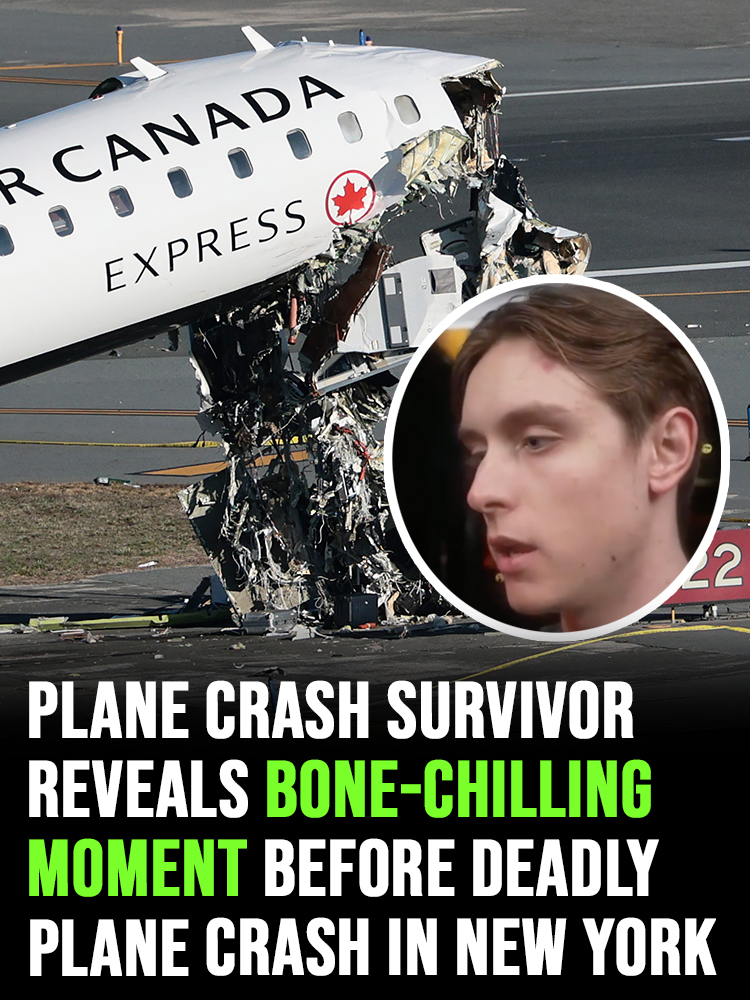
The harrowing aftermath of Sunday’s fatal Air Canada collision at LaGuardia Airport is coming into sharper focus as survivors begin to share their accounts of the carnage inside the cabin. Jack Cabot, a 22-year-old passenger aboard the ill-fated flight, has provided a chilling recollection of the moments following the impact, describing a scene defined by “blood everywhere” and a desperate struggle for survival.
The aircraft, a Bombardier CRJ-900 operating as Jazz Aviation Flight 8646 from Montreal, was carrying 76 souls when it reached the New York tarmac. According to preliminary flight tracking data, the twin-jet was decelerating on Runway 4 at approximately 24 miles per hour when it struck a Port Authority vehicle. While aviation specialists indicate the jet maintained the right of way—meaning the runway should have been entirely sterile—the resulting collision proved catastrophic.
Twelve Seconds of Chaos
For Cabot, who was seated in 18A near the left wing, the transition from a routine landing to a life-altering disaster happened in an instant. “The last 12 seconds were crazy,” Cabot told the NY Post. “The landing suddenly felt wrong. Then there was a huge bang; it was an extremely hard impact.”
In the immediate wake of the crash, the cabin was transformed into a scene of industrial-scale trauma. Cabot recalled seeing a fellow passenger beside him with severe facial injuries and a heavily bleeding nose. Despite the shock, he witnessed a surge of communal instinct among the travelers.
“People really stepped up,” Cabot said. “They worked together as a group.” He described passengers sharing clothing to ward off the cold and one individual using a face mask to wipe blood from the face of a stranger.
A Grueling Evacuation
The geography of the wreckage made the escape a prolonged ordeal. Cabot noted that it took nearly two hours for the aircraft to be fully evacuated, with those seated in the forward section of the fuselage facing the most significant obstacles. Many required substantial physical assistance to be extricated from the mangled wreckage.
The collision claimed the lives of both the pilot and co-pilot and left dozens with varying degrees of injury. Among the most dramatic stories of survival was that of veteran flight attendant Solange Tremblay. During the impact, Tremblay was ejected nearly 300 feet from the aircraft, eventually discovered on the tarmac still strapped into her jump seat. Her daughter has since branded her survival a “miracle.”
In a moment of dark levity, Cabot recalled that Tremblay had served him a beer earlier in the flight. “It gave me a new motto: sit in the middle of the plane and have a beer,” he joked, while acknowledging the gravity of the situation.
Humanity Amid the Wreckage
Despite the violence of the crash, Cabot’s most enduring memory is of the compassion shown by strangers. He recounted seeing an older British woman stay by the side of a young girl who was traveling alone for the first time, offering comfort throughout the entire two-hour evacuation.
“There’s always humanity. People try their best to help each other,” Cabot remarked.
While Cabot suffered a whiplash injury and is currently being monitored for a potential concussion, he remains acutely aware of the thin line between life and death. “I was lucky,” he said. “Some people were hurt much worse.”
As federal investigators continue to probe the breakdown in communication that allowed a ground vehicle onto an active runway, the aviation community remains in mourning for the lost crew and the families forever changed by the events on Runway 4.