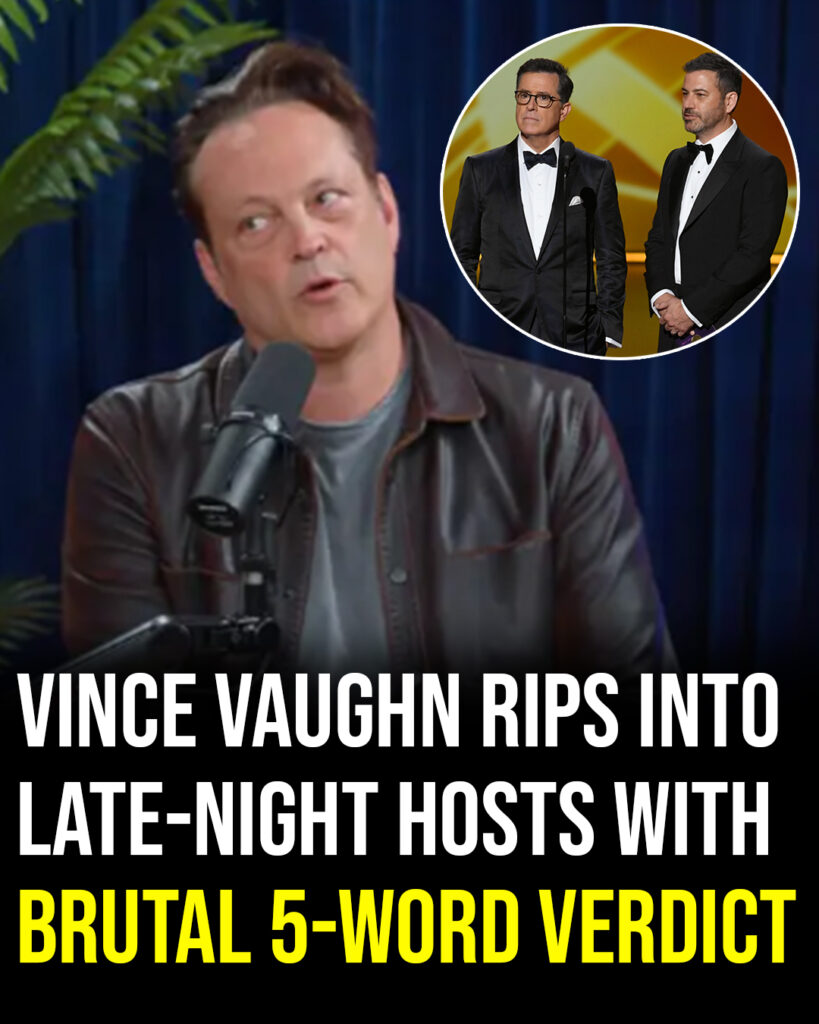
In a candid critique of the modern media landscape, veteran actor Vince Vaughn has signaled a “rejection” of the current late-night television format, arguing that a shift toward partisan lecturing has stripped the genre of its fundamental purpose: entertainment.
Appearing on Theo Von’s This Past Weekend podcast, the 55-year-old Wedding Crashers star suggested that the once-celebrated pillars of late-night have traded punchlines for political evangelism. According to Vaughn, the move has alienated a massive segment of the viewing public who feel less like an audience and more like students in a mandatory lecture.
The “Agenda” Problem
“They never get it right,” Vaughn told Von during the wide-ranging interview. “I think that talk shows, to a large part, became really agenda-based. They were going to [evangelize] people to what they thought. You know what I mean? And so people just rejected it because it didn’t feel authentic. It felt like they had an agenda.”
Vaughn’s assessment posits that the decline in traditional late-night ratings is a direct result of this ideological shift. He argued that the programs “stopped being funny” the moment they leaned too heavily into political commentary, creating an atmosphere that feels more punitive than playful.
“It started feeling like I was f—king in a class I didn’t want to take,” he added. “I’m getting scolded.”
A Flight From Authenticity
While Vaughn stopped short of naming specific hosts, his commentary arrives amid a broader cultural debate surrounding figures like Jimmy Kimmel and Stephen Colbert, both of whom have built modern brands on fierce criticism of Donald Trump.
Vaughn agreed with Von’s suggestion that these shows are struggling because they target an increasingly narrow demographic. In contrast, he noted that viewers are migrating toward the podcasting world because “people want authenticity.”
“If you look at what happened to the talk shows and why their ratings are low, it’s got only to do with the fact… which is they all became the same show,” Vaughn explained. “And they all became so about their politics and who’s good and who’s bad. It’s like, imagine sitting next to someone like that on a f—king plane. You’d be like, bro, how do I get out of this f—king seat?”
A Libertarian’s Middle Ground
Vaughn, who has previously identified as a libertarian, emphasized that his frustration stems from a desire for independent thought rather than a specific partisan loyalty. He noted that he finds himself at odds with both major political platforms.
“There’s s—t I don’t agree with at all, and then there’s s—t I don’t agree with at all,” he said, adding that fundamentally, “nobody wants to be told what to do.”
This commitment to open dialogue has occasionally landed the actor in the crosshairs of social media controversy. In 2020, Vaughn faced significant backlash after a video surfaced of him shaking hands with Donald Trump at a Louisiana State University football game. He later addressed the incident in the Los Angeles Times, clarifying that it was a brief, personable encounter and not a policy discussion.
“I don’t have a party that I support and endorse,” Vaughn said at the time. “In fact, for me sometimes it’s difficult to find a candidate that you feel is philosophically consistent and not just going along with whoever is funding their particular party.”
For Vaughn, the current state of late-night isn’t just a political issue—it’s a creative one. As he sees it, until the late-night circuit returns to its comedic roots and abandons the “scolding” tone, audiences will continue to seek out more authentic, less “consistent” voices in the digital space.