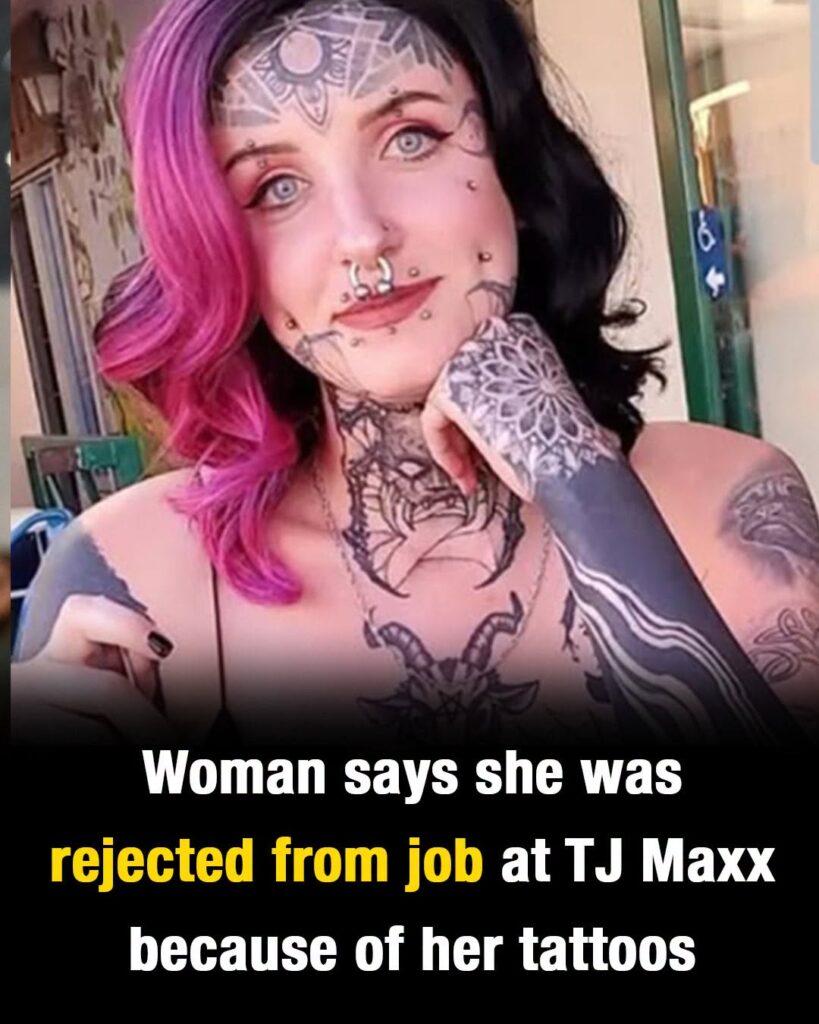
A 24-year-old woman recently sparked a wide online debate after sharing her frustration about being rejected for a retail job at TJ Maxx—and the response she received wasn’t quite what she expected.
Ash Putnam, known on TikTok as ashxobrien, posted a video explaining that she had applied for a position at the store but was turned down through an automated email rather than a personal call. The clip quickly gained traction, drawing millions of views and triggering a flood of opinions.
In the video, Putnam explains that she later visited the store in person to ask why she wasn’t selected. According to her, the hiring manager told her that other candidates had more experience. Still, she wasn’t entirely convinced.
With visible tattoos covering parts of her face and body, along with multiple facial piercings, Putnam openly questioned whether her appearance played a role in the decision. Although she says the manager denied that her tattoos were a factor, she admitted she had doubts.
Looking for broader insight, she turned to her audience, raising a question that resonated with many young viewers: how are people supposed to gain experience if entry-level jobs require it in the first place? She also expressed frustration that her tattoos seemed to define her in professional settings, despite her belief that they have no impact on her ability to work.
Her video quickly became a lightning rod for commentary.
Some viewers responded critically, suggesting that highly visible tattoos—especially on the face—can limit job opportunities, particularly in customer-facing roles. A number of comments were blunt, with some describing such body art as a “career ender,” while others focused specifically on placement rather than tattoos in general.
Several users shared personal perspectives, noting that tattoos elsewhere on the body are often accepted, but facial tattoos still carry stigma in many industries. Others claimed that employers may avoid hiring candidates with bold facial modifications because of how they believe customers might react.
There were also comments from individuals claiming hiring experience. One person identifying as an HR supervisor argued that most companies would hesitate to place someone with highly visible facial tattoos in a front-facing retail role. Another user, who said they had previously worked as a hiring manager at TJ Maxx, echoed that sentiment, suggesting that facial tattoos and piercings could indeed influence hiring decisions.
At the same time, not all responses were dismissive. Some viewers supported Putnam’s argument, emphasizing that personal appearance should not outweigh skills, attitude, or work ethic. They pointed out that workplace norms are evolving and that self-expression—through tattoos, piercings, or unconventional style—should not automatically be viewed as unprofessional.
Putnam herself has maintained that her appearance reflects creativity and individuality, not a lack of professionalism. In follow-up comments and interviews, she argued that companies may need to reconsider outdated standards, especially as younger generations increasingly embrace body art as a form of identity.
The discussion highlights a broader tension in today’s job market. Over the past decade, tattoos have become more widely accepted across many industries, particularly in creative and less formal environments. However, in traditional or customer-facing sectors like retail, hospitality, and corporate services, expectations around appearance can still be more conservative.
From an employer’s perspective, hiring decisions often factor in brand image, customer perception, and workplace policies. From a candidate’s perspective, those same standards can feel restrictive or unfair—especially when they appear unrelated to actual job performance.
The situation ultimately sits at the intersection of evolving cultural norms and long-standing professional expectations. While opportunities for self-expression continue to expand, not all industries have adapted at the same pace.
Whether one sees Putnam’s experience as a case of bias or simply a reflection of current hiring realities depends largely on perspective. What is clear, however, is that conversations like this are becoming more common—and they are gradually reshaping how both employers and employees think about professionalism, identity, and opportunity.