
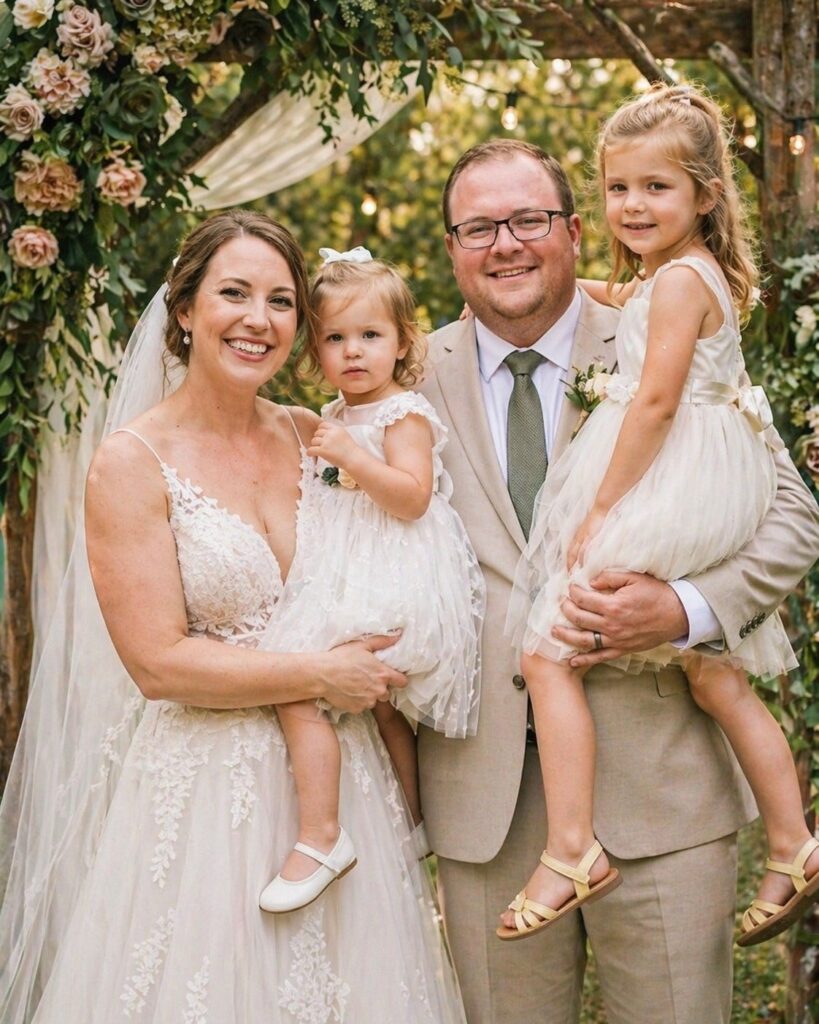
When I married Daniel, I thought I was becoming the missing piece of a broken puzzle. He was kind, patient, and carried the quiet dignity of a man who had survived the unthinkable. His daughters, six-year-old Grace and four-year-old Emily, were the lights of my life from the moment we met. They were beautiful, energetic, and remarkably resilient for children who had lost their mother three years prior. I moved into their large, sun-drenched home with a heart full of hope, determined to build a future where the shadows of the past were respected but no longer dominant.
The house was a dream of wraparound porches and high ceilings, but it held a single, jarring inconsistency: a locked basement door. Daniel dismissed it as a storage space for old tools and hazardous junk, a pragmatic safety measure for a father of two curious girls. I accepted his explanation because I wanted to trust him. However, as the weeks turned into months, I noticed a strange magnetism pulling the girls toward that door. Grace would linger in the hallway, her eyes fixed on the brass knob with a look of profound longing. Emily would stand near the frame, silent and expectant, before scurrying away when she realized I was watching.
The tension finally snapped on a Tuesday afternoon while the girls were home with minor colds. What began as a day of soup and cartoons took a chilling turn when Grace approached me in the kitchen. Her face was devoid of its usual childhood mischief, replaced by a gravity that felt far too old for a six-year-old. She asked me if I wanted to meet her mother. My pulse spiked as she whispered that her mom lived downstairs, and Emily followed behind, nodding solemnly as she dragged her stuffed rabbit across the floor.
Fear is a visceral thing. It felt like a cold blade sliding between my ribs. Every true-crime documentary and psychological thriller I had ever consumed flashed through my mind. I thought of the locked door, Daniel’s occasional late-night disappearances into the bowels of the house, and the girls’ unsettling insistence that a dead woman was residing beneath our feet. Driven by a desperate need for the truth, I used a pair of hairpins to pick the lock. My hands shook so violently I nearly dropped the pins twice, but finally, the mechanism clicked.
I expected a nightmare. I expected to find something grotesque or criminal. Instead, when the door swung open, I was met with the heavy, cloying scent of damp earth and stale air. As I descended the stairs, the dim light revealed not a prison, but a sanctuary. It was a meticulously preserved shrine to a life interrupted. There was a faded floral couch, shelves groaning under the weight of home movies, and walls covered in framed photographs of a woman with a radiant smile. It was a catalog of grief, frozen in time and hidden away from the world above.
The girls rushed past me, comfortable in the gloom. They showed me the tea set where they played “parties” with their mother’s memory and pointed to the television where they watched her ghost dance in grainy home videos. Daniel had created a physical manifestation of his inability to move on. He hadn’t buried his wife; he had simply moved her into the basement. To the girls, she wasn’t a memory; she was a neighbor who lived behind a locked door, someone they could visit when the world felt too heavy.
The sound of the front door opening signaled Daniel’s return. When he found us in the basement, his face went through a kaleidoscope of emotions: shock, terror, and finally, a crushing, hollow shame. The confrontation that followed was the rawest moment of our marriage. He confessed that the basement was the only place where he didn’t have to be the “strong widower” everyone praised. He had kept it locked not to hide a crime, but to hide his own weakness. He admitted that he allowed the girls to believe their mother lived there because he couldn’t find the words to tell them she was truly gone.
I looked at the man I loved and realized that while he had invited me into his bed and his life, he had kept the most significant part of his heart under lock and key. I had been competing with a ghost that was being fed and watered in the dark. I told him then that the basement was a tomb, not a home. By allowing Grace and Emily to believe their mother was just a flight of stairs away, he was trapping them in a cycle of perpetual waiting. They were living in a house of cards, and the foundation was built on a lie that would eventually crush them.
The healing didn’t happen overnight. It began with the door staying unlocked, allowing the light from the hallway to finally spill into the gloom. We spent the following weeks dismantling the shrine, not to erase her, but to integrate her memory into the rest of the house where it belonged. We moved the photographs to the living room and the home movies to the family room. We sat the girls down and explained, through tears and difficult questions, that their mother lived in their hearts and their stories, not behind a wooden door in the basement.
We called a plumber to fix the leaking pipe that had caused the sour smell of rot, and Daniel finally made the call to a therapist he had been avoiding for years. I stayed, though the path forward wasn’t guaranteed. Our marriage had been built over a secret, and we had to tear it down to the studs to see if the structure was worth saving. Today, the basement is just a basement—a place for laundry, old holiday decorations, and the girls’ discarded toys. The “mom” who lived there is gone, replaced by a memory that no longer requires a key to access. We still have bad days, and the grief still visits us like an unwanted guest, but at least now, all the doors in our house are open.