
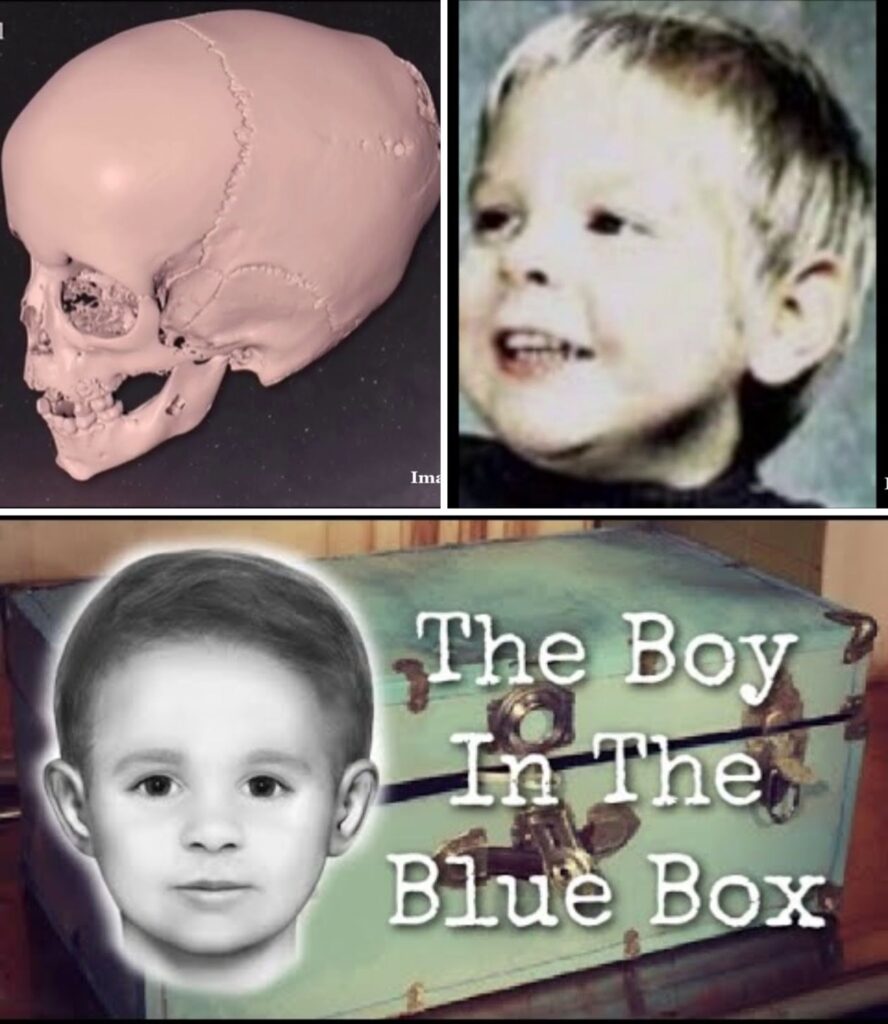
On a biting cold day in late February 1957, the quiet woodlands of the Fox Chase neighborhood in Philadelphia became the center of a mystery that would break the hearts of a nation and haunt investigators for more than six decades. It began when a young man checking his muskrat traps stumbled upon a cardboard box discarded in the underbrush. Inside was not trash, but the remains of a young child, wrapped in a cheap plaid blanket. Fearful of getting involved with the police, the hunter ignored the discovery. It wasn’t until days later, when a college student spotted a rabbit running into the brush and found the same box, that the authorities were finally notified. What they found inside that JC Penney bassinet box would spark the biggest manhunt in the city’s history and leave a permanent scar on the community’s collective conscience.
The child, estimated to be between four and six years old, had clearly suffered immensely in his short life. He was severely malnourished, his small body bearing the marks of extensive surgical scars and bruises. Perhaps most heartbreaking was the condition of his hair; it had been crudely chopped close to the scalp, clumps of hair still clinging to his body, suggesting someone had hurriedly tried to alter his appearance shortly before abandoning him. The police were optimistic at first, believing that someone would surely miss a child. They took his fingerprints and distributed over 400,000 flyers to every household in Philadelphia. They checked orphanages, foster homes, and hospitals. Yet, the phone lines remained silent. No frantic parents called. No neighbors reported a missing playmate. The boy had simply appeared from nowhere, and to the horror of the detectives, it seemed no one was looking for him.
As the weeks turned into months, and months into years, the “Boy in the Box” became a symbol of lost innocence. The case grew cold, but it was never forgotten. Generations of investigators took up the file, driven by a deep sense of duty to give the child his name back. Over the years, countless theories emerged, each seeming promising before crumbling under scrutiny. One of the most persistent theories involved a local foster home located not far from the discovery site. Remington Bristow, a medical examiner’s office employee, spent his own money and time investigating the home. He found a bassinet similar to the box and a blanket hanging on a clothesline that resembled the one found with the boy. Decades later, the foster father’s stepdaughter was implicated, but DNA testing eventually cleared the family, closing yet another door.
Another chilling lead came nearly 45 years after the discovery. A woman known only as “M” came forward, claiming her abusive mother had purchased the boy in 1954. She described a life of horror for the child, whom she said was kept in the basement. Her story contained a detail that sent shivers down the spines of detectives: she claimed the boy had thrown up baked beans shortly before a fatal beating. This was a detail never released to the public, yet the autopsy confirmed the presence of baked beans in the child’s stomach. It seemed like the break they had waited for. However, after extensive interviews, investigators found the woman had a history of severe mental health struggles. Neighbors who lived near her childhood home denied seeing a boy, and ultimately, the lead was deemed unreliable, casting the case back into darkness.
Throughout the decades, the boy was buried in a potter’s field, his headstone reading simply, “Heavenly Father, Bless This Unknown Boy.” However, the dawn of the 21st century brought a new tool to the investigator’s arsenal: genetic genealogy. In 1998, and again in 2019, the child’s remains were exhumed to retrieve DNA samples. The science was tricky; the DNA was degraded, and the sample was small. But a dedicated team, including the famed genealogist Misty Gillis, refused to give up. They began building a massive family tree, looking for connections in the Philadelphia area. They were looking for a needle in a haystack of genetic markers, tracing distant cousins and slowly narrowing down the possibilities.
Finally, the breakthrough came. The genetic map pointed to a prominent family in Delaware County and another family with roots in Philadelphia. By comparing the boy’s DNA with unsuspecting relatives who agreed to submit their own samples, the investigators triangulated the truth. On December 8, 2022, Philadelphia Police Commissioner Danielle Outlaw stood before a room packed with reporters and retired detectives—some of whom had tears in their eyes—to announce that the Boy in the Box was unknown no more. His name was Joseph Augustus Zarelli. Born on January 13, 1953, he was just four years old when his life was tragically cut short.
The revelation of Joseph’s identity painted a complex picture of the era. Joseph was the child of parents who were not married to each other, a situation that carried a heavy social stigma in the 1950s. His birth certificate had been filed, which was a crucial piece of the puzzle, but he had never been issued a social security number, and he had never been enrolled in school. This lack of a paper trail was why the search had been so impossible for so long; socially and bureaucratically, Joseph barely existed outside of his birth record.
It was revealed that Joseph had lived in West Philadelphia near 61st and Market streets. The investigation identified his biological parents, both of whom had passed away by the time the discovery was made. However, Joseph has living half-siblings who were completely unaware of his existence. When approached by police, the family was shocked but cooperative. It appeared that the secret of Joseph’s birth—and his subsequent disappearance—had been guarded intensely by those who knew. The police clarified that the biological father likely did not know the child had passed away in such a manner, or perhaps didn’t know the boy was in danger, though the exact dynamics of who had custody of Joseph in his final days remain a subject of the ongoing investigation.
While the identification of Joseph Augustus Zarelli is a monumental victory for the cold case unit, the story is not entirely over. Knowing his name is only half the battle; knowing who is responsible for his harm is the other. However, the passage of 65 years means that most, if not all, of the adults who would have been involved in Joseph’s life in 1957 have since passed away. The chances of a criminal prosecution are slim to none. Yet, for the community and the law enforcement officers who kept his picture on their desks for decades, this is a form of justice. It validates that Joseph was a person, not just evidence. He was a child who belonged to a lineage, who had a birthday, and who should have had a future.
The cemetery where Joseph rests has now been updated. The headstone that once declared him unknown has been replaced. It now bears his full name and his picture. It is a place of pilgrimage for those who adopted him in their hearts over the years. The story of Joseph Zarelli serves as a somber reminder of the vulnerabilities of children and the secrets that families can keep. But more than that, it is a testament to the relentless pursuit of truth. It proves that no matter how much time passes, and no matter how cold a trail becomes, there are those who will never stop searching until a child is brought home. The Boy in the Box is no longer a mystery; he is Joseph, and he is finally known.