
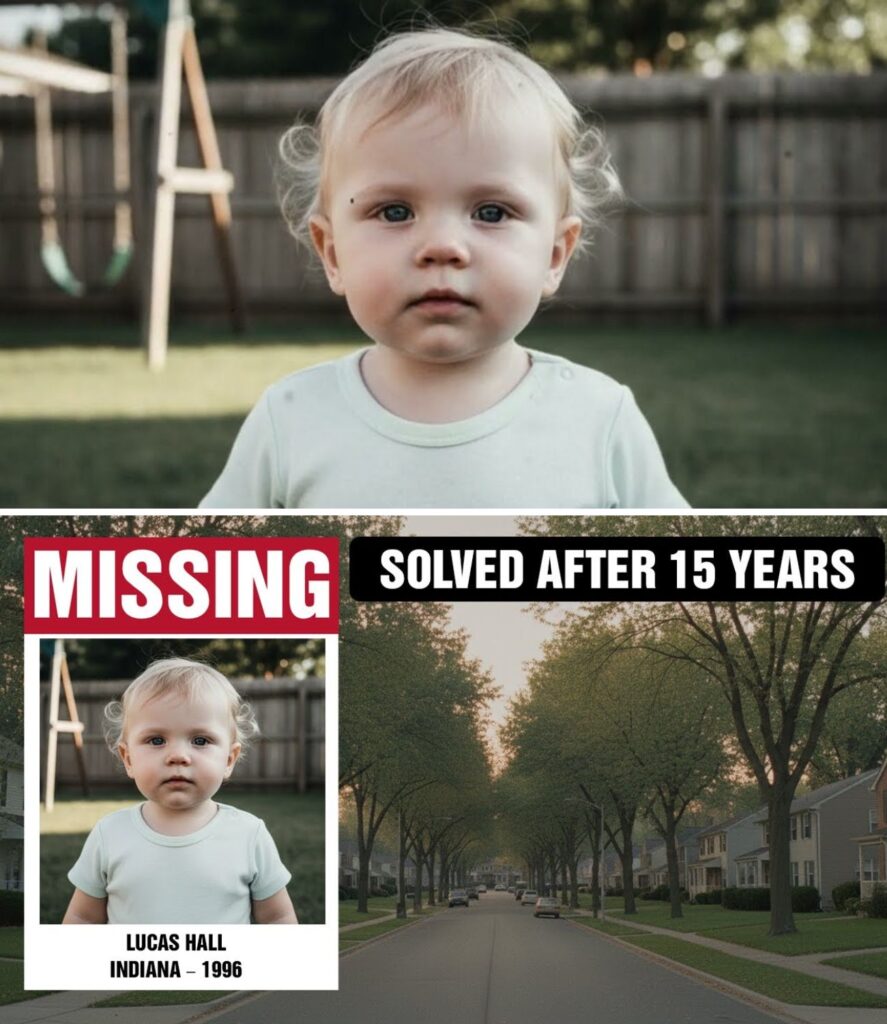
In the mid-nineties, Bloomington, Indiana, was the quintessential picture of Midwestern tranquility. It was the kind of place where neighbors knew each other’s names, children played freely on treelined sidewalks, and the slow pace of life offered a profound sense of safety. For Daniel and Megan Hall, this peaceful environment was the backdrop for their young family’s life. Daniel worked steadily at a local machine shop, while Megan, a librarian at an elementary school, spent her afternoons caring for their one-year-old son, Lucas. Their modest home was filled with the sounds of a growing child and the quiet rhythms of a happy marriage. However, this domestic bliss was shattered in the late summer of 1996 when a momentary lapse in vigilance led to a tragedy that would haunt the community for over a decade.
The disappearance happened in a matter of seconds. On a routine afternoon, while Lucas was playing in his favorite playpen near the living room window, Megan stepped into the backyard for a very brief moment to hang laundry. The back door was unlocked—a common practice in a neighborhood where crime felt like a distant rumor. When she returned just minutes later, the playpen was empty and the room was unnaturally silent. There was no crying, no sound of a toddler’s movements, and no sign that Lucas had managed to climb out on his own. The back door stood slightly ajar, casting a chilling draft into the home. Panic immediately set in as the Halls searched every corner of their property and the surrounding streets, but Lucas had vanished without a single trace.
The initial investigation by the Bloomington Police Department was massive in scale but hampered by a lack of physical evidence. Despite the rapid deployment of search teams and K9 units, the only potential clues were fragmented and inconclusive. Witnesses recalled seeing an unfamiliar man standing near a street corner in the days leading up to the incident, and several others remembered a dark green pickup truck circling the neighborhood with unusual frequency. However, no one could provide a license plate or a clear description of the driver. Forensic teams recovered a single gray fabric fiber from the back door hinge, but in 1996, technology was not advanced enough to link such a small item to a specific person. As weeks turned into months with no new leads, the case gradually went cold, and the Halls were left in a void of unresolved grief.
For fifteen years, the world moved on, but for Daniel and Megan, time was measured in the milestones their son should have reached. They lived in a state of suspended animation, preserving Lucas’s childhood photos and holding onto the slimmest hope that he was still alive somewhere. Unbeknownst to them, Lucas was growing up just a few states away in Ohio, living under a completely different name. His life was governed by a man who had meticulously constructed a false history for him. Using a crudely fabricated birth certificate and exploiting the administrative gaps of the era, the abductor raised Lucas in a state of social isolation, moving frequently and avoiding any situation that required rigorous identity verification.
The breakthrough finally came in 2011, driven by Lucas’s own growing sense of unease. As a teenager, he noticed that his personal records were always a source of trouble at school and at medical clinics. There were no baby photos, no stories of extended family, and the explanations provided by the man who raised him—Evan Ror—were always vague and evasive. Driven by a desire to know his true origins, Lucas secretly purchased a commercial DNA testing kit. When the results were returned, they didn’t just provide a list of distant cousins; they triggered a high-level alert. His genetic profile was an absolute match for the biological data of the Hall family, which had been preserved in the national missing persons database since 1996.
The verification process was swift and definitive. The Indiana State Police reopened the file, and modern forensic technology was finally able to make sense of the clues left behind decades earlier. Re-examining the 1996 evidence with 21st-century tools, investigators found that the gray fiber matched a specific type of work jacket worn by Evan Ror, a seasonal laborer who had been in Bloomington at the time of the disappearance. Furthermore, 3D modeling of the original crime scene photos confirmed that a purposeful entry and exit could have occurred in the exact window Megan was in the backyard. While Ror had passed away several years before the discovery, the technical evidence confirmed he was the sole perpetrator of the fifteen-year deception.
The reunion between the Halls and their son was a moment of overwhelming emotion, though it was also filled with the complexities of a long-term separation. Lucas returned to Bloomington not as the toddler who was taken, but as a sixteen-year-old young man with his own history and defense mechanisms. Rebuilding family bonds required immense patience and professional support. Daniel and Megan had to learn to love the person Lucas had become, rather than clinging to the memory of the baby they had lost. For Lucas, it was a journey of reclaiming a stolen identity and learning to trust a world that had been hidden from him by a man he once thought was his only protector.
Today, the Lucas Hall case stands as a landmark in the history of child protection and forensic science. It serves as a powerful reminder of how technology can bridge the gap of time and how the persistence of hope can eventually lead to justice. The story also highlighted critical vulnerabilities in the way identities were verified in the past, leading to significant updates in how schools and medical facilities handle student and patient records. More importantly, it is a story of human resilience. Lucas Hall’s journey from a hidden life to his rightful home is a testament to the fact that the truth, no matter how deeply it is buried, eventually has a way of coming to the surface.