
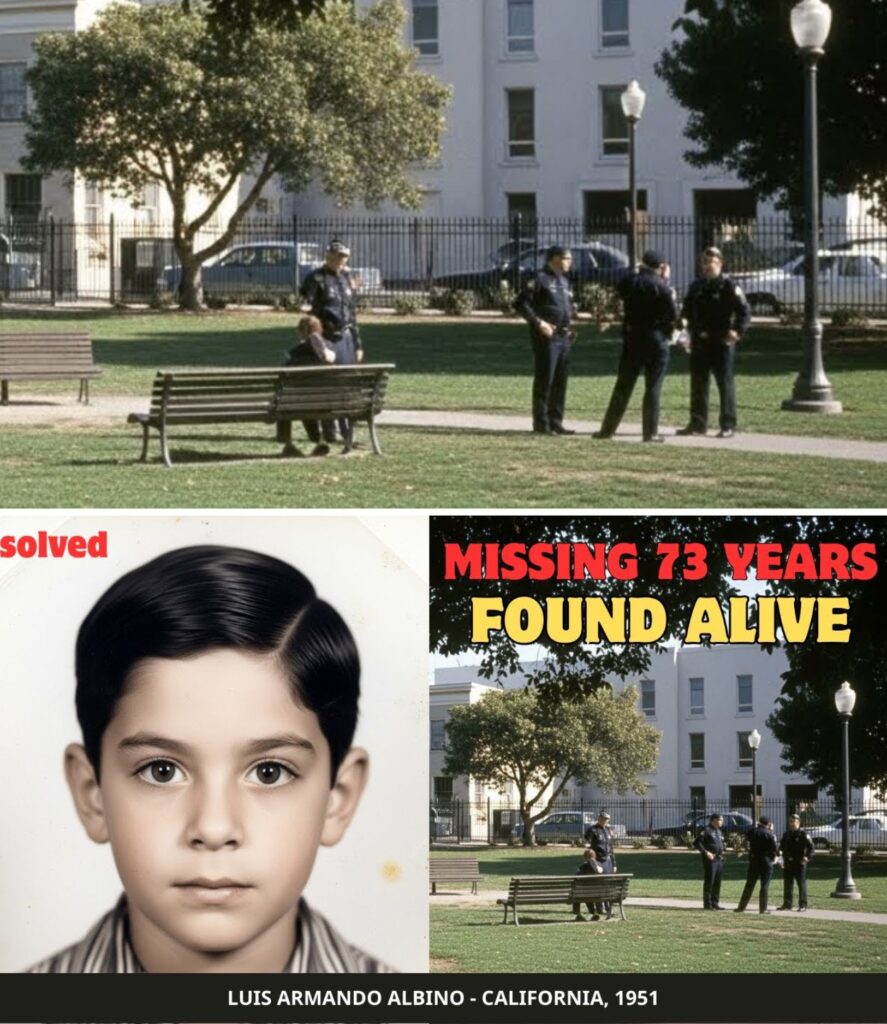
Miracle in Oakland: The Boy Who Vanished for 73 Years Returns Home Just in Time to Say Goodbye
A woman in a red bandana, a promise of candy, and a six-year-old boy gone in the blink of an eye. For seven decades, the Albino family kept a candle burning for Luis. Last year, that flame finally guided him home.
It was February 21, 1951, a day that started like any other in West Oakland, California. The sun was shining on Jefferson Square Park, a patch of green amidst the bustling post-war city. Six-year-old Luis Armando Albino, a bright-eyed boy born in Puerto Rico, was playing with his older brother, Roger. They had moved to California just months prior, chasing the American Dream. Luis, still learning English, laughed and shouted in Spanish as he chased his brother around the swings. But in the periphery, a woman was watching—a woman in a red bandana who would change the course of their lives forever.
According to Roger, who was ten years old at the time, the woman approached them with a warm smile. She spoke to Luis in Spanish, a familiar comfort in a new land. She bent down to his level, her voice soft and inviting, and made a promise that every child finds hard to resist: candy. Roger watched, hesitant but not immediately alarmed, as his little brother took the woman’s hand. As they walked away, Roger’s instinct screamed that something was wrong. He ran home to tell his mother, but by the time help arrived, the woman and Luis had vanished into the city fog.
For the next 73 years, that moment would haunt Roger. It was the last time he saw his brother as a child. The police scoured the city, soldiers from a nearby base formed human chains, and the Coast Guard dragged the murky waters of the bay. But the trail had gone cold almost instantly. Luis Armando Albino had become a ghost, a face on a milk carton before milk cartons were even a thing. But while the world moved on, his mother, Antonia, made a vow: she would never stop looking. And she never did, until her dying breath.
The story of the search is one of agonizing persistence. Antonia Albino kept her son’s photo in her wallet every single day. She set a place for him at the dinner table on holidays. She spoke of him in the present tense, telling her other children, “He is alive. I feel it here,” pressing a hand to her heart. Even when the police closed the file, even when decades rolled by and the black-and-white photo yellowed, the family refused to let Luis become just a statistic. They kept his memory alive, passing the torch of hope from generation to generation.
That torch eventually landed in the hands of Alida Alequin, Luis’s niece. Growing up, she heard the stories of the uncle who was stolen. In 2020, amidst the quiet boredom of the pandemic, Alida decided to take an Ancestry DNA test. She wasn’t looking for a miracle; she was just curious about her heritage. But when the results came back, they showed a 22% match with a man listed only by a username—a man with no paternal family tree. That percentage was too high to be a coincidence. It screamed “uncle.”
Alida reached out, but silence followed. For years, the message sat unread or ignored. It wasn’t until early 2024 that Alida and her daughters decided to push harder. They went to the Oakland Public Library, pulling microfilm reels of old newspapers. They found the article from 1951, the photo of Luis in his striped shirt, and the photo of a stunned young Roger standing next to his mother. The pieces were fitting together. They took their findings to the Oakland Police Department, and for the first time in decades, the authorities listened.
This wasn’t just a cold case anymore; it was a solvable puzzle. The FBI and the California Department of Justice joined the effort. They tracked down the man on the East Coast—a Vietnam veteran, a retired firefighter, a grandfather. He had lived a full, honorable American life, completely unaware that an entire family in California had been mourning his loss for nearly three-quarters of a century. He remembered fragments—a woman, a train ride, a new mom who spoke differently—but he had buried them deep.
When the DNA test confirmed the match, the impossible became reality. Luis was alive. The reunion was set for June 2024. The FBI flew Luis to Oakland, and in a quiet room, away from the media circus, two brothers stood face to face. Roger, now 82, looked at the man who used to be the boy in the striped shirt. “I’m sorry I didn’t stop her,” Roger reportedly said, the guilt of a ten-year-old boy finally finding a place to rest. Luis simply hugged him. They had found each other.
But this story has a bittersweet ending that feels scripted by a Hollywood dramatist. Just two months after their miraculous reunion, Roger passed away. He held on just long enough. He waited 73 years to see his brother again, and once that circle was closed, he let go. It is a tragedy, yes, but also a profound mercy. They got their summer. They got to sit on the porch, share meals, and bridge the gap of a lifetime.
Analysis: The Weight of a Stolen Life
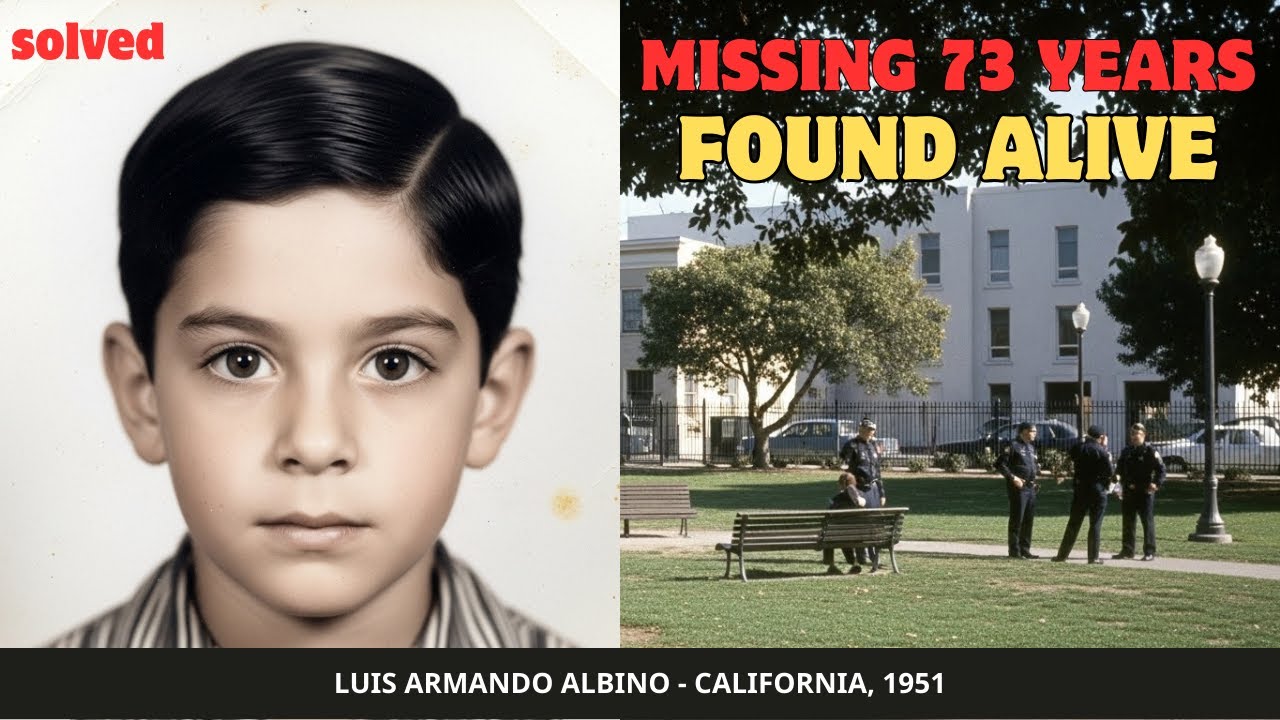
What does it mean to lose 73 years? For Luis, it meant a life built on a foundation of lies, yet a life that was still undeniably “good.” He served his country in Vietnam, he saved lives as a firefighter, and he raised a loving family. It raises uncomfortable questions about identity and destiny. If that woman in the red bandana hadn’t taken him, who would he have been? Would he have survived the poverty his family faced? Would he have still become a hero?
The revelation also highlights the double-edged sword of consumer DNA testing. For years, these tests were fun novelties for finding out if you were 10% Irish. Now, they are the most powerful investigative tool in history. They are tearing down walls of secrecy that kidnappers and criminals thought were impenetrable. The woman who took Luis—likely long dead—probably thought she had gotten away with it. She didn’t. Science caught up.
For the Albino family, this is closure, but it is also a reopening of wounds. They have to reconcile the joy of finding Luis with the grief of knowing their mother, Antonia, died without ever holding him again. She passed away in 2005, nineteen years before the miracle happened. That is the true tragedy here: the stolen moments that can never be returned. But her faith was vindicated. She was right. He was alive.
Netizen Reactions: Tears, Goosebumps, and Anger
The internet has been completely dismantled by this story. It’s the kind of narrative that cuts through the noise of political bickering and viral trends.
“I am sobbing at my desk,” wrote one user on X (formerly Twitter). “The fact that Roger waited for him… he held on just to make sure his brother was okay. That is the definition of love.”
On TikTok, true crime communities are buzzing with theories about the kidnapper. “Who was the woman in the red bandana? Was she a neighbor? Did she sell him? We need to know who she was!” one commenter demanded, echoing the frustration of many who want justice, not just reunion.
Others are focusing on the niece, Alida. “Can we give Alida a medal? She didn’t give up. She went to the library, she pestered the cops. She is the real MVP of this story,” read a top comment on Facebook.
There is also a wave of existential reflection. “Imagine waking up at 79 and finding out your whole life started with a crime. That has to be mind-blowing. Luis is so strong for handling this with grace,” said a Reddit user in a thread discussing the case.
And of course, the emotional kicker: “Antonia knew. Mothers always know. I hope she’s watching from somewhere, finally at peace.”
Conclusion: The Power of Never Giving Up
The story of Luis Armando Albino is a testament to the endurance of the human spirit. It reminds us that “cold case” does not mean “hopeless case.” It teaches us that love can stretch across decades, across state lines, and even beyond the grave.
Roger Albino can rest in peace now, his watch finally ended. Luis can live the rest of his days knowing exactly who he is and where he came from. And Alida Alequin has shown the world that sometimes, all it takes is a little curiosity and a lot of determination to rewrite history.
To our readers: have you ever taken a DNA test? Did you find anything surprising? A distant cousin, a family secret? This technology is changing the definition of family every day.
Tell us your stories in the comments below. And if you have a missing loved one, let this be your sign: Don’t give up. The answer might be just a cheek swab away.
The Deep Dive: How the Investigation Unfolded
The sheer mechanics of this discovery are worth examining because they illustrate just how much the world has changed since 1951. When Luis disappeared, DNA wasn’t even fully understood as the building block of life, let alone a forensic tool. The police of 1951 relied on physical descriptions, shoe leather, and luck. They had no cameras, no databases, no way to track a child once they crossed a county line.
Fast forward to 2024. The investigation that Alida kickstarted was a masterclass in modern detective work. It wasn’t just the DNA; it was the combination of DNA and old-school archival research. The fact that Alida and her daughters went to the library to pull microfilm is a crucial detail. In an age of digital ease, they put in the manual labor to find the proof they needed to get the police to take them seriously.
The Oakland Police Department deserves credit here, too. It is all too easy for busy departments to dismiss a 73-year-old case as a waste of resources. But they didn’t. They recognized the validity of the DNA hit and allocated the manpower to verify it. This cooperation between a civilian sleuth (Alida) and law enforcement is the future of cold case solving.
The “Woman in the Red Bandana”: The Unsolved Mystery
While we celebrate the reunion, a shadow remains. Who was she? The description given by 10-year-old Roger was specific: a woman in her 30s, speaking Spanish, wearing a red bandana. This suggests she might have been local, or at least familiar enough with the culture of the neighborhood to blend in.
Was she a grieving mother who had lost a child? Was she part of a black-market adoption ring? In the 1950s, informal and illegal adoptions were not uncommon. Children were sometimes taken from poor families and “placed” with wealthier ones, often with falsified documents. The fact that Luis was flown to the East Coast suggests resources. Air travel in 1951 was expensive. This wasn’t a crime of opportunity by a transient; it was a planned abduction with an endgame.
Luis has stated he doesn’t bear ill will. “Whoever took me gave me a good life,” he reportedly said. This is a stunning display of forgiveness, or perhaps a coping mechanism. To hate the people who raised him would be to hate the only parents he knew. It adds a layer of psychological complexity to the story that is hard to fathom.
A Legacy for the Future
This case will be cited in criminal justice textbooks for years to come. It proves that the “statute of limitations” on hope does not exist. It also serves as a warning to anyone holding onto dark family secrets: the truth is in the blood, and the blood eventually talks.
For the Albino family, the holidays will be different this year. There will be grief for Roger, certainly. But for the first time in 73 years, the empty chair at the table won’t be empty anymore. Luis might not be there in person every day, but he is no longer a ghost. He is Luis Armando Albino, the boy from the park, the brother who came back.
Share this article if you believe in miracles. Let’s get this story to every corner of the internet to honor Antonia, Roger, and the relentless Alida.
Timeline of Events:
February 21, 1951: Luis is abducted from Jefferson Square Park.
1951-2005: Antonia Albino searches daily until her death.
2020: Alida Alequin takes an ancestry DNA test “just for fun.”
2024: Alida finds the match and goes to the library to build her case.
March 2024: Oakland Police reopen the investigation.
June 2024: Luis is confirmed found and reunited with Roger.
August 2024: Roger Albino passes away.