
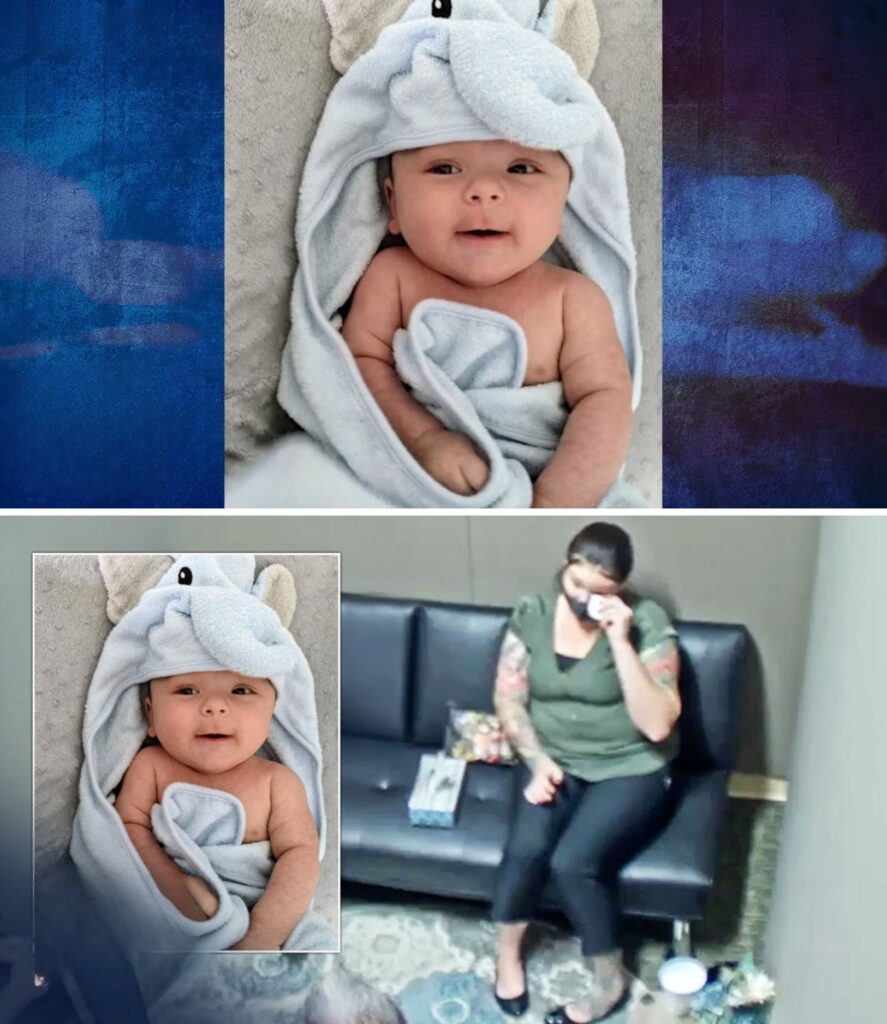
The night of November 8, 2021, in Sarasota, Florida, was the kind of evening that felt deceptively ordinary, the sort of quiet humidity that blankets the suburbs in a false sense of security. Inside the Scheip household on Spring Oaks Circle, the domestic scene appeared mundane enough to be invisible. There was the smell of dinner lingering in the air, the flicker of a television set entertaining a toddler, and the soft, rhythmic breathing of a newborn baby. But by 9:30 PM, that silence would be shattered not by the wail of a siren, but by the frantic pounding of a mother’s fist on a neighbor’s door. Lily Scheip, a 31-year-old nurse and mother of two, stood on that porch, her eyes wide with a terror that seemed almost too performative to be real, cradling the limp, blue body of her 14-week-old son, Dominic.
She didn’t have her phone. She didn’t call 911 from her own home. Instead, she ran into the night, screaming for help, thrusting her dying child into the arms of a neighbor who happened to be a nurse. It was a scene straight out of a prime-time medical drama, chaotic and heart-wrenching. Neighbors rushed to help, performing CPR on the cold concrete of a garage floor, desperate to coax a breath back into the tiny lungs. Lily watched, her hands trembling, her story already beginning to form in the fractured logic of a mind under siege. She claimed she had found him unresponsive in his bassinet. She claimed he was fine just moments before. But as the paramedics loaded little Dominic into the ambulance and the red lights swept across the manicured lawns of Sarasota, the first cracks in Lily’s perfect façade were already beginning to show.
Dominic never woke up. He was rushed to Tampa General Hospital, where doctors fought a losing battle against injuries that made no sense for a baby who had simply “stopped breathing.” There was no obstruction in his throat. There was no genetic defect ticking away like a time bomb. Instead, there was violence. Brutal, unexplained violence. The medical team found severe head trauma—swelling, bleeding, the kind of damage that comes from force, not nature. And there was something else, something even more chilling: evidence of old injuries. Partially healed fractures that whispered of a history of pain in his short, 14-week life. On November 10, two days after his mother ran out into the night, Dominic was taken off life support. He died in a hospital bed, surrounded by machines, while detectives began to circle the grieving mother like sharks sensing blood in the water.
To the outside world, Lily Scheip was the picture of suburban stability. She was a nurse, a profession built on care and empathy. She was a wife to her husband, Pete, and a mother to her toddler son, Lucas. She navigated the stressors of modern motherhood—the sleepless nights, the balancing act of work and home—with what seemed like quiet resilience. But behind the closed doors of their Sarasota home, a different reality was festering. It was a reality marked by isolation, unspoken resentment, and a darkness that was slowly consuming her. The investigation into Dominic’s death would peel back these layers, exposing the raw, ugly nerve of a woman who had simply, and catastrophically, snapped.
The interrogation of Lily Scheip is a masterclass in the psychology of denial. It wasn’t a screaming match. There were no tables flipped or lights swung in her face. Instead, it was a slow, agonizing conversation in a sterile room, where detectives Sarah and her partner methodically dismantled Lily’s defenses with soft voices and hard evidence. When they first brought her in on November 19, just over a week after the incident, Lily was helpful. She was cooperative. She sat there, hands clasped, playing the role of the grieving, confused mother to perfection. She walked them through her day with the precision of someone reciting a script. Dinner. Chicken. Pete leaving for band practice. The baby sleeping. The discovery.
“I went back in the room to see if Dominic had fallen asleep,” she told them, her voice trembling just enough to be convincing. “He wasn’t breathing. His lips were blue.” She described the panic, the missing cell phone, the run to the neighbor’s house. It was a compelling narrative, one that tugged at the heartstrings of anyone who has ever feared for a child. But the detectives weren’t listening to the emotion; they were listening to the timeline. They were looking for the gaps. And the biggest gap was the two hours between when Pete left the house and when Lily ran for help. Two hours where she was alone with a defenseless infant. Two hours that would become the black box of this investigation.
The detectives let her talk. They let her spin her version of events, nodding sympathetically as she described her attempts to save him. But then, they began to introduce the anomalies. They asked about the “brown liquid” she claimed to have seen coming from Dominic’s mouth. Lily latched onto this detail, describing it vividly. “He was very junky,” she said. “There was brown liquid coming out of his mouth.” She suggested it was aspiration, a tragic medical accident where the baby choked on his own vomit. It was a convenient explanation, one that absolved her of guilt and placed the blame on biology. But the medical examiner’s report didn’t support it. Dominic didn’t choke. He was beaten.
The tension in the interrogation room shifted on December 2, when Lily returned for a second interview. This time, her attorney was by her side, a silent sentinel in a losing battle. The detectives dropped the pretense of a routine inquiry. They laid the cards on the table. “We’ve got some unexplained injuries to Dominic’s head,” one detective said, her voice dropping an octave, becoming serious, heavy. “We need an explanation.” Lily’s reaction was almost imperceptible at first—a slight stiffening of the shoulders, a flicker of the eyes. “I don’t have an explanation,” she said flatly. It was the mantra she would repeat over and over again, a shield of feigned ignorance against the barrage of facts.
The detectives pressed harder. They brought up the leg fractures from September. Two broken legs on a newborn? It was a glaring red flag that had somehow been missed or explained away at the time. Lily had a story for that, too. She blamed her toddler, Lucas. She described an elaborate scenario involving a recliner, a 2-year-old jumping, and a freak accident where the baby fell and twisted his leg. “Lucas isn’t an aggressive boy,” she insisted, “maybe a little attention deficit, but not aggressive.” She painted a picture of a chaotic household where accidents just happened, where little boys were boisterous and babies were fragile.
But the detectives weren’t buying it. They knew the force required to break a baby’s femur is significant. It doesn’t happen from a toddler stumbling on a chair. It happens from twisting, from snapping, from rage. They walked her through the physics of her story, and piece by piece, it fell apart. “You grabbed the sock,” the detective clarified, visualizing the impossible mechanics of her claim. “All you got was sock.” Lily nodded, trapped in her own fabrication. The implication was clear: the previous injury wasn’t an accident. It was a rehearsal. A warning shot that had gone unheeded by the world, leaving Dominic vulnerable to the final, fatal assault.
As the interrogation wore on, the detectives shifted tactics. They stopped asking what happened and started suggesting why it happened. They offered her a lifeline, a way to confess without being a “monster.” They talked about postpartum depression. They talked about the stress of raising two kids while her husband was out at band practice. They empathized with her isolation, her exhaustion. “I can’t imagine for two seconds being in your shoes,” the detective said, her voice dripping with calculated compassion. “You’re taking care of everything. Pete is not as involved as he should be.”
It was a brilliant psychological maneuver. By validating her feelings of being overwhelmed, they gave her permission to admit to a “moment of madness.” They painted a picture of a mother pushed to the brink, not by malice, but by circumstance. Lily listened, tears streaming down her face. You could see the internal struggle, the war between self-preservation and the crushing weight of the truth. She admitted to feeling depressed. She admitted to the stress. “I think I may have been suffering from postpartum,” she whispered. It was the closest she had come to an admission.
Then came the “repressed memory” defense. It’s a trope in true crime for a reason—it allows the perpetrator to detach themselves from the act. “Is it possible,” the detective asked gently, “that something happened that you just can’t remember? A blackout? A moment of shock?” Lily seized on this. “I believe that it’s a matter of shock and trauma that I can’t recollect,” she said. She was trying to thread a needle, to admit that something happened without admitting she did it. She was practically begging them to tell her that she wasn’t evil, just broken. “I need an explanation as well,” she cried, casting herself as another victim of the tragedy.
But the police didn’t need her to remember. They had the autopsy. The medical examiner had found fresh impact injuries on the back of Dominic’s head—injuries that occurred within the window of time Lily was alone with him. They had ruled out the CPR causing the damage. They had ruled out a fall. The only variable in the room was Lily. The circle of suspicion had tightened into a noose. “The only other alternative is that you don’t want to tell us what happened,” the detective said, her voice hardening. “Your son is dead, and there is a reason for it.”
Despite the mounting pressure, Lily never gave them the “Perry Mason moment.” She never broke down and screamed, “I did it!” She hid behind the wall of “I don’t know” until the very end. But her silence was as damning as a confession. The inconsistencies in her story—the swaddling versus the pajamas, the brown liquid location, the timeline—created a mosaic of guilt that no amount of tears could wash away.
It took four months for the authorities to build their case. On March 15, 2022, the Sarasota County Sheriff’s Office finally moved. Lily Scheip was arrested and charged with second-degree murder. The community was stunned. The nurse next door, the mom at the playground—she was a child killer. The arrest brought a wave of revulsion, but also a strange sense of validation for those who had sensed something “off” about the tragedy. The “accidental” leg breaks were seen in a new, horrifying light. They weren’t accidents; they were torture.
Lily spent years behind bars awaiting trial, her life in the outside world continuing without her. Her husband, Pete, was left to pick up the pieces of a shattered family, raising their surviving son in the shadow of a monstrous betrayal. The legal process dragged on, a slow grind of motions and hearings, until August 2025, when Lily finally faced a jury of her peers. The charge had been high stakes: murder. But the defense team, led by attorney Jason Miller, fought tooth and nail. Their argument was nuanced and infuriating to the prosecution: they argued that there was no “ill will,” no “evil intent.” They painted Lily not as a killer, but as a negligent, overwhelmed mother who snapped.
The jury bought it. In a verdict that shocked court watchers, they found her guilty not of murder, but of manslaughter. It was a significant downgrade, a legal acknowledgement that while she killed her son, she didn’t mean to. The distinction mattered little to the dead, but it meant everything for Lily’s future. Instead of a life sentence, she was facing a maximum of 15 years.
The sentencing hearing in late 2025 was an emotional bloodletting. Pete’s parents, Dominic’s grandparents, stood before the court and demanded the maximum. “Dominic’s death has cast a permanent shadow over our family,” his grandmother said, her voice trembling with a mixture of grief and rage. They wanted her to rot. They wanted the key thrown away. On the other side of the aisle, Lily’s parents pleaded for leniency, still clinging to the image of their daughter as a good person who made a terrible mistake. “I can’t imagine in my wildest imagination her hurting my grandson intentionally,” her father said. It was a courtroom divided by two versions of the same woman.
The judge, weighing the jury’s verdict and the raw emotion of the room, handed down the sentence: 10 years in prison, followed by four years of probation. But here is the kicker, the detail that makes the internet rage: because Lily had already spent nearly four years in jail awaiting trial, she was credited for time served. She would likely be walking free in five years. Five years for the life of a baby. Five years for the skull fractures, the broken legs, the terror of those final moments.
The online reaction to the verdict and sentencing was volcanic. The internet, with its collective judge, jury, and executioner mentality, exploded with indignation. “Five more years? That’s it?” one user commented on the trial footage. “She broke his legs before she killed him. That’s not negligence, that’s a pattern. That’s torture.” Another user, a mother herself, wrote, “I have postpartum depression. It’s hard. It’s dark. But I never, ever thought about smashing my baby’s head. This is an insult to mothers everywhere who struggle but don’t kill.” The “repressed memory” defense was particularly torn apart. “Convenient how she remembers the chicken nuggets and the band practice but ‘forgets’ the murder,” a top comment read. “She’s not traumatized; she’s a narcissist protecting her own image.”
There was also sympathy, albeit controversial, for the husband, Pete. Many wondered how he missed the signs. “The leg break should have been the end of it,” one armchair detective noted. “If my kid broke two legs ‘falling’ from a chair, I’m not leaving him alone with the person watching him. The system failed that baby, but so did the family.” It’s a harsh judgment, one made with the benefit of hindsight, but it echoes the tragic reality that Dominic was failed by everyone who was supposed to protect him.
The case of Lily Scheip serves as a grim reminder of the darkness that can reside behind the most ordinary of doors. It challenges our perceptions of motherhood, forcing us to confront the uncomfortable truth that the instinct to nurture is not always universal. It forces us to question how well we really know our neighbors, our friends, even our spouses.
For the residents of Spring Oaks Circle, the yellow house will always be marked. It’s the place where the ambulance came. It’s the place where the baby died. And for the rest of the world, Lily Scheip will remain a polarizing figure—a monster to some, a tragic figure of mental illness to others, but ultimately, a woman who erased her own child from existence.
As Lily sits in her cell, counting down the days to her release, one has to wonder what she remembers now. Does the fog of “repressed memory” lift in the silence of a prison night? Does she see the blue lips? Does she hear the silence of the bassinet? Or has she rewritten the story in her mind so completely that she believes her own lie? The truth is locked away in the mind of a woman who played the role of the perfect mother until the curtain fell, leaving only a tragedy in its wake.
Justice, in this case, feels incomplete. Dominic George Scheip lived for 14 weeks. He knew pain. He knew fear. And then he was gone. Ten years can never balance that scale. As the internet moves on to the next outrage, the next true crime sensation, Dominic’s story remains a somber note in the symphony of the forgotten—a baby boy who deserved to grow up, but who was stopped by the very hands that brought him into the world.
What do you think? Was the manslaughter verdict fair, or did Lily Scheip get away with murder? Does the legal system fail victims when it accepts defenses like “repressed memory”? Share your thoughts in the comments below—let’s keep the conversation, and Dominic’s memory, alive.