
Found After 42 Years: The Miracle in The Villages and the DNA Match That Rewrote History
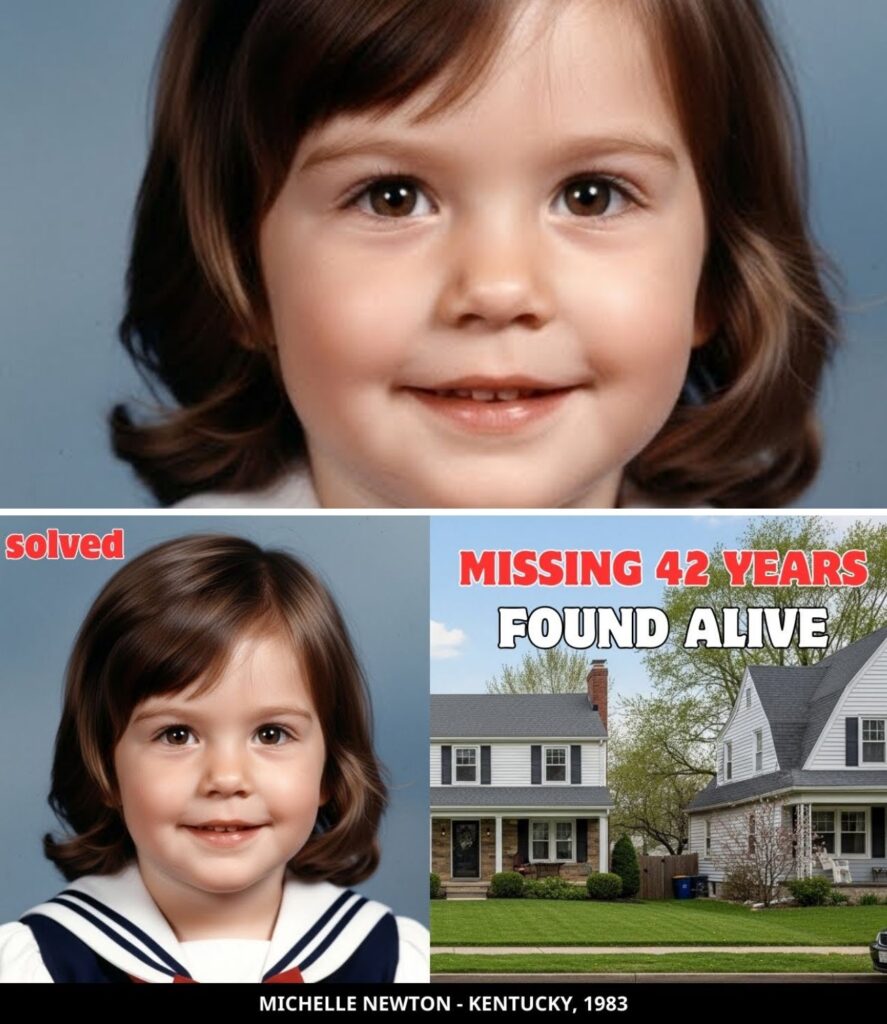
It is a statistical anomaly, a whisper of hope in a world of dead ends, and quite possibly the most miraculous true crime resolution of the decade. Imagine setting a place at the Thanksgiving table for an empty chair, not just for a year or two, but for 42 consecutive years. Imagine keeping a bedroom frozen in time—stuffed animals on the shelf, a crib in the corner—waiting for a toddler who vanished in the era of Ronald Reagan to walk back through the door as a middle-aged woman. For Joseph Newton, this wasn’t just a heartbreaking fantasy; it was his daily reality. But on a humid November morning in Florida, that reality shattered in the most spectacular way possible. Michelle Marie Newton, the little girl in the sailor dress who disappeared in 1983, has been found alive. And the twist? She was living a quiet, unremarkable life just states away, completely unaware that she was the center of one of the country’s oldest cold cases.
The Day the Music Died: Louisville, 1983
To understand the magnitude of this discovery, we have to rewind the tape to the spring of 1983. It was a simpler time—Flashdance was on the radio, and the fear of “stranger danger” was just starting to grip the American suburbs. But for the Newton family in Louisville, Kentucky, the danger wasn’t a stranger in a van; it was much closer to home. Joseph “Joe” Newton was a hardworking 33-year-old father, deeply in love with his three-year-old daughter, Michelle. Known as “Shelly,” she was the kind of child who lit up a room—dark pigtails, a gap-toothed smile, and a penchant for nautical dresses that made her look like a living doll.
The plan was supposed to be exciting: a family relocation to Georgia for better work and a fresh start. Deborah Lee Newton, Joe’s wife and Michelle’s mother, was set to drive down first to scout apartments. On April 2, 1983, Joe kissed them both goodbye. He watched Deborah buckle Michelle into her car seat. The toddler waved—a small, innocent gesture that would be Joe’s last memory of her for nearly half a century. “We’ll be waiting for you,” Deborah promised. But the call to say they had arrived never came.
Days turned into weeks. The silence from Georgia was deafening. Joe called every number, checked every lead, and eventually drove south himself, knocking on doors in Clayton County until his knuckles were raw. The police initially treated it as a domestic spat—a common dismissal in the 80s when mothers took children. But as the months dragged on, the reality set in: this wasn’t a break; it was a vanishing.
The Long, Cold Silence
For 42 years, the case of Michelle Newton sat in the “unsolved” filing cabinets of the Jefferson County Sheriff’s Office. It was a case that haunted generations of detectives. There were no bodies, no crime scenes, just a car that drove away and never arrived. In 1985, a grand jury indicted Deborah for custodial interference, a felony that put her on the FBI’s radar. For a brief, terrifying moment, she was one of the “Top Eight” most wanted for parental kidnapping. Her face was in post offices; Michelle’s age-progressed sketches were in Reader’s Digest. But the tips were always ghosts—mistaken identities, false hope, and dead ends.
Joe Newton, however, never purged the ghost from his house. He refused to move. He refused to redecorate Michelle’s room. He became a living monument to the missing, a father frozen in 1983. In interviews, his message was always the same, delivered with a voice that cracked under the weight of decades: “I just want to know she’s okay.”
The investigation suffered the indignities of time. Charges were technically dismissed and then reinstated. Michelle’s name was purged from active databases due to clerical policies on “non-suspicious” long-term absences. To the world, she was gone. To the system, she was a closed file. But to a few stubborn detectives and a persistent father, she was still out there.
The Tip That Changed Everything
The breakthrough didn’t come from a high-tech dragnet or a guilty conscience. It came from the most modern of sources: an internet sleuth. In early 2025, a woman reading about old cold cases online made a connection that professional investigators had missed. She looked at the age-progressed photo of Deborah Newton—imagined as a woman in her 50s—and saw a striking resemblance to a neighbor in The Villages, Florida. The neighbor, a quiet retiree named Sharon Neely, kept to herself, walked her dog, and paid her taxes. But the eyes—those dark, slightly downturned eyes—were a match.
The tipster called Crime Stoppers. It was a thin lead, the kind detectives usually roll their eyes at. But Detective Mark Harland, a veteran of the force who had reopened the file in 2016, felt a prickle of intuition. He didn’t dismiss it. He dug. Property records showed “Sharon Neely” was the right age. Her birth date was dangerously close to Deborah’s.
Harland flew to Florida. He sat in an unmarked car, watching a woman buy groceries and water her lawn. He took photos with a long lens. When he laid the surveillance shots next to the grainy 1983 polaroids, the 42-year gap seemed to evaporate. It was her.
The DNA Gamble
But in 2025, you don’t arrest grandmothers based on a hunch. You need science. Harland played his ace card: genetic genealogy. He approached Deborah’s younger sister, Lisa, back in Louisville. Lisa, who had carried the guilt of her sister’s disappearance for decades, readily provided a DNA sample.
Then came the stealth operation. Florida police, armed with a warrant for a reference sample, knocked on “Sharon Neely’s” door. She didn’t fight. She didn’t run. She simply opened her mouth for the swab, a resignation in her eyes that spoke volumes. The lab expedited the test. The results were a mathematical thunderclap: 99.9997% probability of a maternal match. Sharon Neely was Deborah Newton. And if Deborah was found, the question that had burned for 42 years had an answer.
Michelle was alive.
The Arrest and The Revelation
On November 24, 2025—two days before Thanksgiving—police moved in. Sharon Neely was arrested in her driveway, carrying a tote bag, on her way to the post office. “I didn’t do anything,” she said initially, but as the cuffs clicked, she whispered the truth that had likely played on a loop in her head since the Reagan administration: “I never meant for it to go on this long.”
But the real drama was unfolding 30 miles away in Ocala. Social workers knocked on the door of Alexis Marie Carter, a 46-year-old veterinary technician who loved dogs and lived a quiet, single life. They sat her down and told her the impossible: Her name wasn’t Alexis. Her mother wasn’t just eccentric; she was a fugitive. And her father wasn’t dead, as she had been told for four decades. He was alive, he was in Kentucky, and he was waiting for her.
The video describes the moment Michelle saw the photos—the sailor dress, the father she didn’t know—as a collision of realities. She didn’t cry immediately. She went numb. The narrative of her entire existence had just been exposed as a fiction.
The Reunion: “I Didn’t Know I Was Missing”
The phone call that followed is the stuff of cinematic legend. Joe Newton, now an old man in a house filled with ghosts, heard his daughter’s voice for the first time since she was a toddler. “I didn’t know I was missing,” she told him. It is a sentence that encapsulates the unique tragedy of parental abduction—the victim doesn’t even know they are a victim.
Michelle flew to Louisville the next day. She walked up the driveway she had stumbled down as a baby. She saw the oak tree. She saw the man who had kept her room dusted for 42 years. They hugged—a tentative, terrified, overwhelming embrace. Joe whispered, “You’re home.”
They spent Thanksgiving together. A table set for two, finally.
ANALYSIS: The Complexity of “Found”
While the headlines scream “Happy Ending,” the reality is a psychological minefield. Michelle Newton is not just a missing child returned; she is a woman whose identity has been shattered. Dr. Eleanor Vance, a trauma specialist (not involved in the case), notes: “This isn’t just a reunion; it’s a demolition of self. Michelle has to reconcile that the mother she loved—and likely still loves—is also her kidnapper. She has to mourn the 42 years she lost with her father while simultaneously building a relationship with a stranger she is genetically bonded to. It is a profound trauma wrapped in a miracle.”
For Deborah, the legal road is grim. Charged with custodial interference, she faces felony counts that could see her spending her twilight years in prison. The internet is divided on this. Is she a monster who stole a child’s life? Or is she a desperate woman from a different era who got in too deep? The fact that Michelle was well-cared for complicates the narrative for the public, but not for the law.
NETIZEN REACTIONS: The Internet Explodes
The story has gone viral, trending under #MichelleFound and #TheVillagesMystery. The reactions are a mix of tearful joy and righteous anger.
@TrueCrimeJunkie88 (Twitter/X): “I am SOBBING. He kept her room? For 42 YEARS? That is the purest love I have ever heard of. Joe Newton is a saint. #MichelleNewton”
@Floridaman_Chronicles: “Only in The Villages. You think you know your neighbors, and boom—she’s on the FBI’s Most Wanted list from the 80s. Crazy.”
@LegalEagle_Esquire: “Unpopular opinion: The mom needs jail time. You don’t get to steal a father’s entire life and just say ‘oops’ 40 years later. That’s psychological torture.”
@GenXer_Memories: “I remember seeing those flyers in the 80s. I never thought they’d find her. This gives me hope for the milk carton kids. DNA is a godsend.”
@PsychStudent24: “Imagine finding out your whole life is a lie at 46. Michelle is the real victim here. I hope she gets massive therapy.”
CONCLUSION: A Candle in the Dark
The resolution of the Michelle Newton case is a testament to the stubbornness of hope and the relentless march of technology. It reminds us that “cold case” is just a label, not a verdict. Somewhere, in another quiet neighborhood, another missing child might be living a borrowed life, waiting for a tip, a test, or a text to bring them home.
For Joe Newton, the wait is over. The silence has been broken. And for the rest of us, it is a reminder to look a little closer at the faces around us—because you never know who is hiding in plain sight.
What do you think? Should Deborah Newton face prison time for her 42-year deception, or does her age and Michelle’s safety warrant leniency? Sound off in the comments below—this is a debate that is just getting started.