
A debate over disability, broadcast standards and racism has intensified in the wake of an incident at the British Academy Film Awards in which a profoundly offensive racial slur was heard in the auditorium and later transmitted in the BBC’s delayed broadcast.
The moment occurred on Sunday night at London’s Royal Festival Hall as actors Michael B. Jordan and Delroy Lindo, both part of the cast of the film Sinners, were on stage presenting an award. From the audience, Tourette syndrome campaigner John Davidson, who attended as a guest of the ceremony, was heard shouting the slur during an involuntary verbal tic.
The BBC broadcast the ceremony roughly two hours after the live event and the language remained in the programme, as well as on the broadcaster’s streaming platform until Monday morning. The corporation has since launched what it called a fast-tracked investigation into how the broadcast edit failed, with its Director-General instructing the Executive Complaints Unit to provide a full response to complainants. In a statement carried by Reuters, Culture Secretary Lisa Nandy said: “Broadcasting a racial slur is completely unacceptable and harmful. The BBC must ensure that this never happens again.”
Davidson attended the awards after his life inspired the film I Swear, which was nominated for several awards. BAFTA has said Davidson is an executive producer of the film and has devoted his life to education and campaigning around Tourette syndrome. The condition can involve sudden, repetitive, involuntary sounds or movements known as tics, including verbal tics that may include swearing.
BAFTA issued a formal apology the day after the ceremony, describing the language heard in the room as “very offensive language that carries incomparable trauma and pain for so many.” In its statement, BAFTA said it had taken measures to inform attendees that Davidson was present and that “they may hear strong language, involuntary noises or movements during the ceremony.” It added: “Early in the ceremony a loud tic in the form of a profoundly offensive term was heard by many people in the room. Michael B. Jordan and Delroy Lindo were on stage at the time, and we apologise unreservedly to them, and to all those impacted. We would like to thank Michael and Delroy for their incredible dignity and professionalism.” BAFTA said Davidson chose to leave the auditorium and watch the rest of the ceremony from a screen, and added: “We take full responsibility for putting our guests in a very difficult situation and we apologise to all.”
The BBC’s initial apology, also carried by Reuters, said some viewers may have heard “strong and offensive language” during the awards, adding: “This arose from involuntary verbal tics associated with Tourette syndrome, and as explained during the ceremony it was not intentional. We apologise that this was not edited out prior to broadcast and it will now be removed from the version on BBC iPlayer.”
The decision-making around what was and was not removed from the recorded programme has become part of the backlash. Reuters reported that later in the ceremony, director Akinola Davies Jr. said “Free Palestine” during an acceptance speech, a remark that was edited out of the broadcast, highlighting questions from critics about editorial choices and the feasibility of removing the slur before transmission.

The incident has also drawn condemnation from figures in the film industry and beyond, including those focused on the impact on the presenters who were on stage at the time. Actor Wendell Pierce, a co-star of Jordan on The Wire, wrote on X, according to Reuters, that it was infuriating the two actors did not receive what he described as a full and immediate apology. “The insult to them takes priority,” Pierce wrote. “It doesn’t matter the reasoning for the racist slur.”
Sinners production designer Hannah Beachler also criticised the handling of the moment. Reuters reported she said it had been an “impossible situation” but that the “throw-away” apology had made it worse, adding: “Of course we were offended.”
Alongside condemnation, the controversy has also triggered a surge of online debate about how Tourette syndrome can manifest in public and how “coprolalia”, the clinical term for involuntary swearing or obscene utterances, is understood by the public. It is in that space that a voice with a different lived experience has entered the discussion.
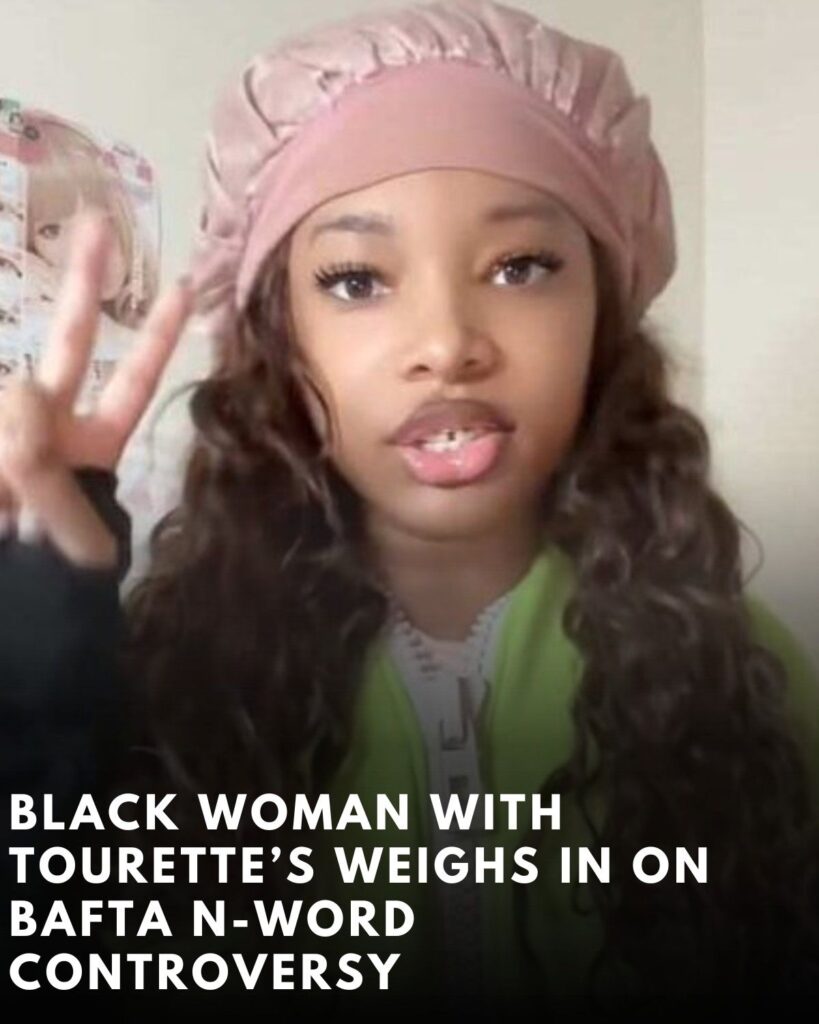
A Black British woman with Tourette syndrome, who performs as a DJ and uses the name Versatile, posted a two-part video on TikTok in which she addressed the incident and the competing claims being made about Davidson’s intent. Versatile said her video was left unedited to demonstrate the severity of her own tics. In the clip referenced by LADbible, she described how Tourette syndrome can involve vocal tics and the way certain words or sounds can be picked up and repeated. “If he hears something, if he is around something, he can pick up the sounds or the words,” she said. “Unfortunately, at some point in his life, he has picked up that N word.”
Versatile said she could not speak to Davidson’s personal beliefs, adding she did not know him, but argued the focus should be on the nature of the condition rather than trying to determine intent from a tic. LADbible reported that she described it as an “involuntary tic” and suggested debating whether he is racist was not relevant to the medical mechanism she was discussing.
She also pointed to what she described as prior awareness by organisers, arguing there should have been better safeguards to protect both the people on stage and those in the room who would be harmed by hearing the word. “Everyone at the BAFTAs was briefed about him coming and what his condition is,” she said in the clip quoted by LADbible. “They even said he might say something he doesn’t mean due to his tics. People were aware of that.”
Versatile added that, in her account, the slur was not the only offensive utterance heard from Davidson that evening. “Before even saying that N word when he said it he was saying multiple obscenities the whole time,” she said. “That was not the first thing that he said.” She argued factors such as stress, anxiety and new environments can increase tics. “It’s a new environment, he’s around people, his anxiety’s high, he’s ticcing more. Stress can also be a factor of increased tics,” she said.
In comments she gave to LADbible, Versatile placed responsibility on organisers and the broadcaster for the eventual harm caused by the broadcast. “I think there should have been ALOT more safeguarding to protect both parties in this situation,” she said. “Due to our knowledge of it not being live and having a 1-2 hour delay, there was time for them to censor out the N-word the same way there was time to edit out ‘Free Palestine’.” She added: “I think the weight of this lays on both the BBC and the BAFTAS for failing to adhere and act in accordance to censorship policies and laws. As a result there has been harm and offence caused and blame shifted. This whole scenario could have been efficiently avoided and more duty of care could have been considered so everyone felt comfortable and catered for.”
Davidson has said he is “deeply mortified” by the incident. In a statement reported by Sky News, he said he was “deeply mortified if anyone considers my involuntary tics to be intentional or to carry any meaning.” He also said he left the ceremony early because “I was aware of the distress my tics were causing.”
Further details of his account have appeared in subsequent interviews. LBC quoted Davidson as questioning the placement of a microphone near his seat. “I remember there was a microphone just in front of me, and with hindsight I have to question whether this was wise, so close to where I was seated, knowing I would tic,” he said. He also described a feature of his condition known as echolalia. “I am often triggered by what I see and/or what I hear, and this part of the condition is called echolalia,” he said. “For example, when the chair of Bafta started speaking on Sunday, I shouted, ‘Boring.’” He added that he would like reporting to reflect that the slur was not the only involuntary outburst that night: “I would appreciate reports of the event explaining that I ticked perhaps 10 different offensive words on the night of the awards.”
As the BBC’s investigation proceeds, the row has become a test of how live and near-live entertainment programmes protect participants and audiences when offensive language, whether intentional or involuntary, occurs in the room. It has also become a stark example of how disability-related explanations can collide with the reality of racial trauma when an especially loaded term is spoken in a public setting and then amplified through broadcast.