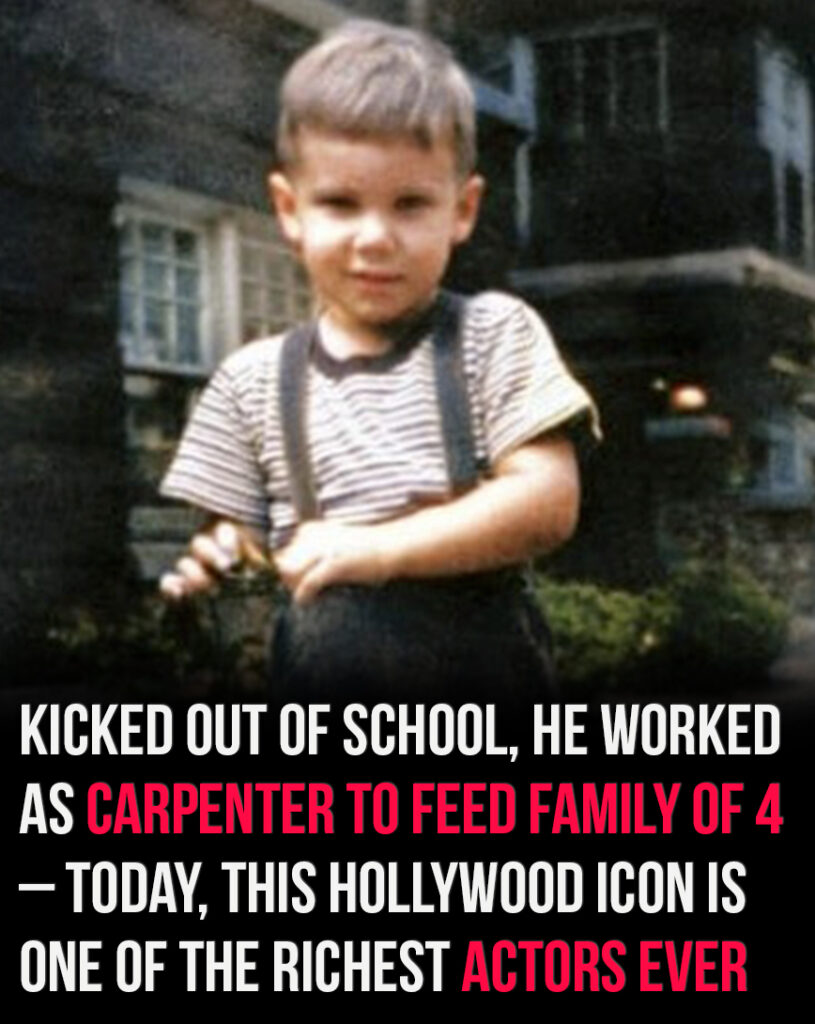
In the modern firmament of Hollywood, few stars shine with the rugged, enduring constancy of Harrison Ford. He is a world-class leading man, a cinematic shorthand for the reluctant hero, and an actor whose name is synonymous with the highest-grossing franchises in history. Yet, the man who would become Han Solo and Indiana Jones did not ascend to the A-list through the typical channels of nepotism or overnight luck.
Instead, his journey is a masterclass in the slow burn—a story of a “late bloomer” who spent years swinging a hammer to support his family before the galaxy finally called his name.

Roots of a “Liberal of Every Stripe”
While many of his contemporaries were born into the velvet-roped world of Tinseltown, Ford’s origins were rooted 2,000 miles away in the Midwestern soil of Chicago. Born in 1942, his heritage was a distinct American blend: a father of Irish Catholic descent who made his living in advertising, and a mother whose Jewish family had fled the Russian Empire for the promise of Illinois.
The future icon was raised in a three-bedroom Tudor in the quintessential suburb of Park Ridge. It was a home defined by the politics of the era. When asked about his religious upbringing, Ford famously quipped, “Democrat,” before clarifying that he and his brother were “raised to be liberals of every stripe.” Looking back on the friction and harmony of his dual heritage, Ford once provided a piercing insight into his own identity: “As a man, I’ve always felt Irish; as an actor, I’ve always felt Jewish.”
He describes those early years as “relatively uneventful and middle-class,” but the stability of that happy childhood provided the foundation for a work ethic that would later save his career.

The College Debacle and the Long Road West
Ford’s entry into the performing arts was almost accidental. While studying English and Philosophy at Ripon College in Wisconsin, he signed up for a drama course in his final year, cynical enough to believe it would be an “easy A.” To his surprise, the self-described introvert found that the stage offered a unique refuge. Despite his nerves, he discovered a profound love for the mechanics of storytelling.
However, academic rigor was not his forte. ”My grade point average was dreadful—terrible,” Ford later admitted. The situation reached a nadir just days before graduation when he was expelled from college for plagiarism. It was a humiliating setback, but it provided the necessary jolt to move. In 1964, with nothing to lose, he packed his bags and headed for Los Angeles.

The “Workman’s Point of View”
Hollywood did not initially roll out the red carpet. While he managed to secure a contract with Columbia Pictures’ new talent program, Ford’s refusal to “play the game” nearly ended his career before it began. After reportedly offending producer Jerry Tokofsky, Ford found himself buried at the bottom of the studio’s casting list. He managed to scrape by with bit parts in Westerns like Gunsmoke, but the roles were uninspired and the pay was meager.
Faced with the responsibility of providing for his first wife, Mary Marquardt, and their two young sons, Ford made a pivot that would become the stuff of legend. Unwilling to accept mediocre roles just to pay the bills, he taught himself carpentry.
“Through carpentry, I fed my family and began to pick and choose from among the roles offered,” Ford told the Daily News in 1986. “I could afford to hold out until something better came along. I never gave up my ambition to be an actor… I was frustrated, but never felt defeated by my frustration.”
Working as a carpenter for the Hollywood elite—including literary icons Joan Didion and John Gregory Dunne—allowed Ford to keep his dignity while remaining in the orbit of creators. It was this dual life that eventually caught the attention of a young director named George Lucas.
From Bob Falfa to the Millennium Falcon
Ford’s “break” was not a singular event but a series of incremental wins. Lucas first cast him as the drag-racing Bob Falfa in American Graffiti (1973). Despite the film’s success, Ford returned to his tool belt, appearing in only a handful of prestigious projects over the next several years, including Francis Ford Coppola’s The Conversation and a small but memorable turn in Apocalypse Now.
The definitive turning point came when Lucas hired Ford, not as an actor, but as a facilitator to read lines for other performers auditioning for a “space-opera” called Star Wars. Ford’s cynical, world-weary delivery of the Han Solo lines—intended merely to provide a foil for the auditioning actors—ended up being exactly what Lucas needed.
The 1977 release of Star Wars shattered every existing box-office record and effectively ended Ford’s days of professional woodworking. By the time he donned the fedora for Raiders of the Lost Ark, Ford had achieved a level of “star power” that allowed him to command the screen with a charisma that felt earned, not manufactured.
The $300 Million Blue-Collar Star
As of 2026, Harrison Ford’s net worth is estimated at a staggering $300 million. Yet, even as one of the highest-grossing actors in the history of the medium, he famously refuses to adopt the affectations of a movie star.
”As a friend once said, the collar around my neck is blue,” Ford shared. “I approach all work from a workman’s point of view. I expect to get my hands dirty, get into a sweat and work overtime.”
This groundedness extends to his private life on his 800-acre ranch in Jackson, Wyoming. There, alongside his third wife, Calista Flockhart, Ford lives a life that prioritizes the land over the limelight. He is an avid pilot—a passion that famously nearly cost him his life in a 2015 crash that left him with a broken back and shattered pelvis—and a dedicated woodworker who still enjoys the smell of sawdust.

The “Endless Springtime”
Ford’s marriage to Flockhart, whom he met at the 2002 Golden Globes (after reportedly spilling wine on her to get her attention), has been his most enduring partnership. Despite a 22-year age gap, the pair found a deep commonality. By adopting Flockhart’s son, Liam, Ford embraced fatherhood for the fifth time later in life. “It’s a wonderful opportunity to be part of a child’s growing up, which is always an endless springtime,” he told Reader’s Digest.
Even at 83, Ford remains a relentless worker. From the Western grit of 1923 to the comedic nuances of Shrinking, he continues to defy the industry’s penchant for ageism. He remains notoriously private—brushing off rumors of social anxiety by stating he simply has “an abhorrence of boring situations”—and prefers the company of his family to the vanity of the red carpet.
Harrison Ford’s legacy is not just the characters he played, but the way he played them: with the precision of a craftsman and the soul of a man who knows exactly what it costs to build something meant to last. From the carpentry shop to the Kessel Run, Ford has proven that perseverance is the ultimate tool.