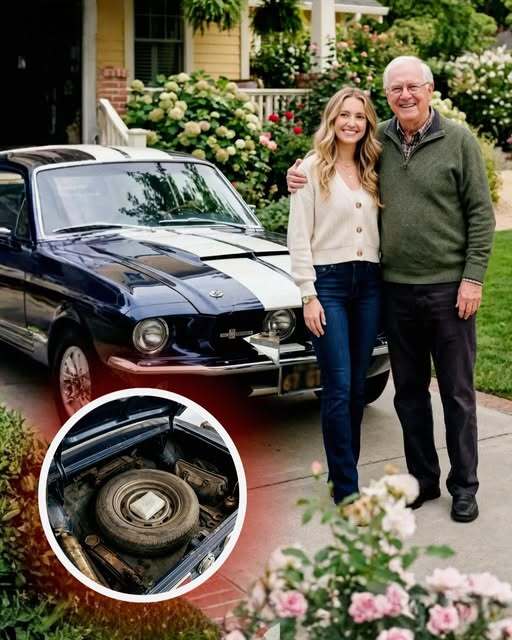
The morning of my father’s funeral felt like a hazy blur of cold coffee and digital ghosts. I stood alone in the quiet kitchen, scrolling through old photos on my phone, desperate to find one detail I hadn’t already memorized—a certain wink, a crooked smile, or the way sunlight used to reflect off the polished chrome of his 1967 Shelby Mustang. That car wasn’t just a machine; it was a mechanical diary of his life. He had spent thirty years restoring it, bolt by bolt. It held his pride, his stubbornness, and in many ways, his heart, all wrapped in vintage steel.
Looking at a photo of him with his arm around me, laughing, I suddenly realized my stepmother Karen was missing from nearly every memory. She had always been on the edges of our lives—present, but never fully part of us. When her name appeared on my phone that morning, a cold knot tightened in my stomach.
Her voice on the line was shaky and thin as she said she was too overwhelmed to attend the service. She blamed stress and doctor’s orders, leaving me to carry the weight of the hardest day of my life alone. I didn’t have the energy to argue. My own car was in the shop, so I had been driving my dad’s Shelby all week. Every drive felt like a final tribute, like one last journey with him beside me. I parked at the church, the engine’s rumble fading beneath me, and rested my head on the steering wheel in silence before going inside.
I gave the eulogy with a trembling voice, speaking about how my father never gave up on the things he loved, especially when life became difficult. I thought I was honoring him properly. But I had no idea that outside those church walls, his legacy was already being taken apart.
When the service ended and I stepped back into the sunlight, I froze. The Shelby was gone. In its place was a flatbed truck with its ramps lowered like open jaws. Karen stood nearby in dark sunglasses, holding a thick white envelope, while a man with a clipboard waited beside her.
Before my father was even laid to rest, she had sold his most prized possession for just two thousand dollars.
It felt like a physical blow. She insisted it needed to be gone immediately, that it was “just a car,” and that the buyer couldn’t wait. My Aunt Lucy was furious, calling it a disgrace to sell a man’s legacy on church grounds. But Karen remained cold, saying I would get through it and that my father would have understood. I watched helplessly as the flatbed drove away, taking thirty years of memories with it.
I felt completely hollow, as if the last piece of him had been torn out of my life. I sank onto the curb, trying not to break down, while Karen paced nervously nearby—more anxious than greedy, which only made it worse.
Then, just as everything felt at its darkest, a silver sedan pulled into the lot. A young mechanic named Pete stepped out quickly, carrying a sealed plastic bag. He looked shaken and asked for me by name.
He explained that during a routine inspection for the buyer, they had discovered something hidden in the trunk, deep under the spare tire. Karen tried to grab the bag, calling it useless junk, but when she finally saw what was inside, her face went pale. The envelope slipped from her hands and fell to the ground.
Inside was a collection of documents and a letter written in my father’s familiar block handwriting.
One of the papers was a receipt for a fifteen-thousand-dollar luxury cruise. As I read the letter aloud, the air around us seemed to collapse.
My father wrote that he knew Karen better than she thought. He knew that if she was reading this, it meant she had sold the Shelby. He admitted he was never perfect and that he had struggled deeply after my mother’s death, even years after their divorce. The cruise, he explained, was meant as a surprise—a final attempt to reconnect and save what was left of their marriage. He hadn’t kept the Shelby out of spite, but because it was the last link he had to his own father.
He had been trying, in his own imperfect way, to hold everything together.
Silence followed, heavy and suffocating. Karen sank to the curb and began to cry, realizing she had unknowingly destroyed something far more valuable than a car.
But there was more.
At the end of the letter, my father had written a message just for me. He told me I had always been the best part of him. He urged me not to let bitterness shrink my heart, even in pain, and to stay generous even when it was difficult. He made it clear that everything he left behind was to be divided equally between Karen and me.
Pete, clearly moved, said he could still stop everything—the sale hadn’t been fully finalized. His boss would reverse it if necessary.
I took a deep breath and felt something steady rise inside me. I wasn’t just his daughter anymore—I was responsible for carrying out his wishes. I told Pete to halt the sale immediately and contact his boss. I also told Karen that she could no longer make decisions on her own and that everything would go through the estate lawyers from now on.
My Aunt Lucy stood beside me firmly, making sure Karen understood that control had shifted. There would be no more secret decisions, no more impulsive actions.
As the sun lowered behind the church, stretching long shadows across the ground, I felt a strange calm settle in. The Shelby was still out there for now, but I held the spare key tightly in my hand, knowing it would come home again.
Grief is heavy, but my father had left me something to carry it with. He had always taught me not to give up on what matters.
I looked one last time at a photo of us in the garage—hands dirty, both of us smiling. In that moment, I understood that while both Karen and I had failed him in different ways, he had still left us a path forward.
I wasn’t ready to forgive, but I was ready to take control.
And as I walked away with Aunt Lucy, leaving the church behind, I knew that even though my father was gone, his voice was still guiding me home.